ACL 2026 Findings | FreedomAI والجامعة الصينية في هونغ كونغ (شنتشن) وشركاؤهما يطلقون DentalGPT، نموذجًا كبيرًا متعدد الوسائط لصحة الفم: 7B معامل ودقة متوسطة تفوق GPT-5 في خمسة معايير لطب الأسنان
هذه المقالة غير متوفرة بالعربية بعد، وفيما يلي النسخة الإنجليزية.
A panoramic radiograph shows the entire dentition, while fillings, root canal treatments, impacted teeth and periapical lesions often occupy only a small part of it. For general-purpose multimodal models, "seeing" these details is already difficult, and making accurate judgments from them is harder still. The paper finds that on the panoramic radiograph benchmark MMOral-OPG-Bench, leading models such as GPT-5, Gemini-2.5-Pro and Claude-Sonnet-4.5 all score below 60% accuracy; even with "thinking mode" switched on, their gains on oral tasks are clearly smaller than in other medical fields.
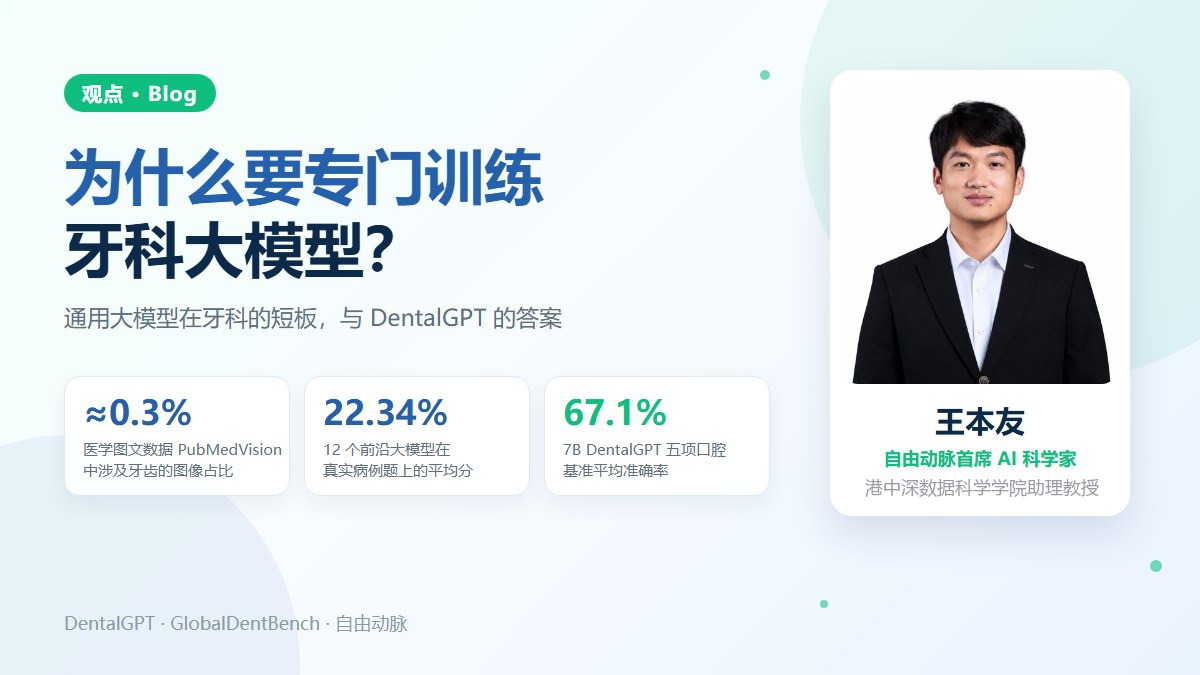
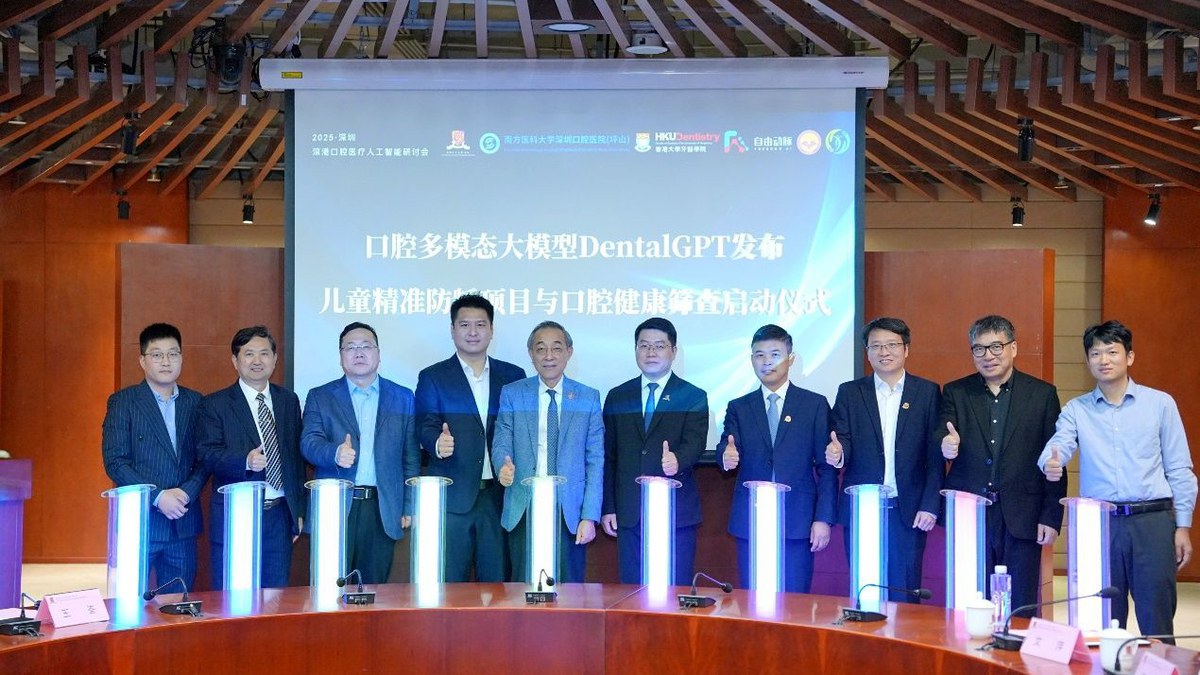
To address this, FreedomAI, together with The Chinese University of Hong Kong, Shenzhen, Shenzhen Stomatology Hospital (Pingshan) of Southern Medical University, the Faculty of Dentistry of The University of Hong Kong, Peking University and other institutions, has released DentalGPT, a multimodal oral-health large model. The team gathered more than 120,000 dental images with diagnosis-related descriptions, first performed multimodal alignment, and then used reinforcement learning to elicit complex reasoning. With only 7B parameters, DentalGPT reaches an average accuracy of 67.1% on five dental benchmarks, above GPT-5's 59.2%. DentalGPT was launched in Shenzhen on December 4, 2025, and the paper has been published in Findings of ACL 2026.
Paper: DentalGPT: Incentivizing Multimodal Reasoning in Dentistry
Published in: Findings of ACL 2026 (July 2026)
Link: https://aclanthology.org/2026.findings-acl.135/
Preprint: https://arxiv.org/abs/2512.11558
Project page: https://github.com/FreedomIntelligence/DentalGPT
Affiliations: Shenzhen Stomatology Hospital (Pingshan) of Southern Medical University; The Chinese University of Hong Kong, Shenzhen; Peking University; FreedomAI; Faculty of Dentistry, The University of Hong Kong; and others
Background: why general models can't read dental images
The paper identifies two causes:
- Perception: dental image–text data is scarce, so models understand dental images poorly and have few cues to reason from. In the preprint, the authors counted that images involving teeth make up only about 0.3% of PubMedVision, a large medical image–text dataset.
- Cognition: reinforcement learning for oral-health questions remains largely unexplored, so models struggle to learn the reasoning patterns specific to dentistry.
The paper illustrates the problem with an example: asked to count the teeth with fillings on a panoramic radiograph (the correct answer is 10), GPT-5 answers about 6, the non-thinking version of Qwen3-VL-235B-A22B counts 16, and its thinking version settles on 8 after repeated self-checking. The models find the relevant visual features but fail to reach the correct answer from them.
Method: first learn to "see", then learn to "think"
DentalGPT is built on Qwen2.5-VL-7B-Instruct in three steps: data collection, multimodal alignment and reinforcement learning (Figure 1). Both training stages update all parameters.
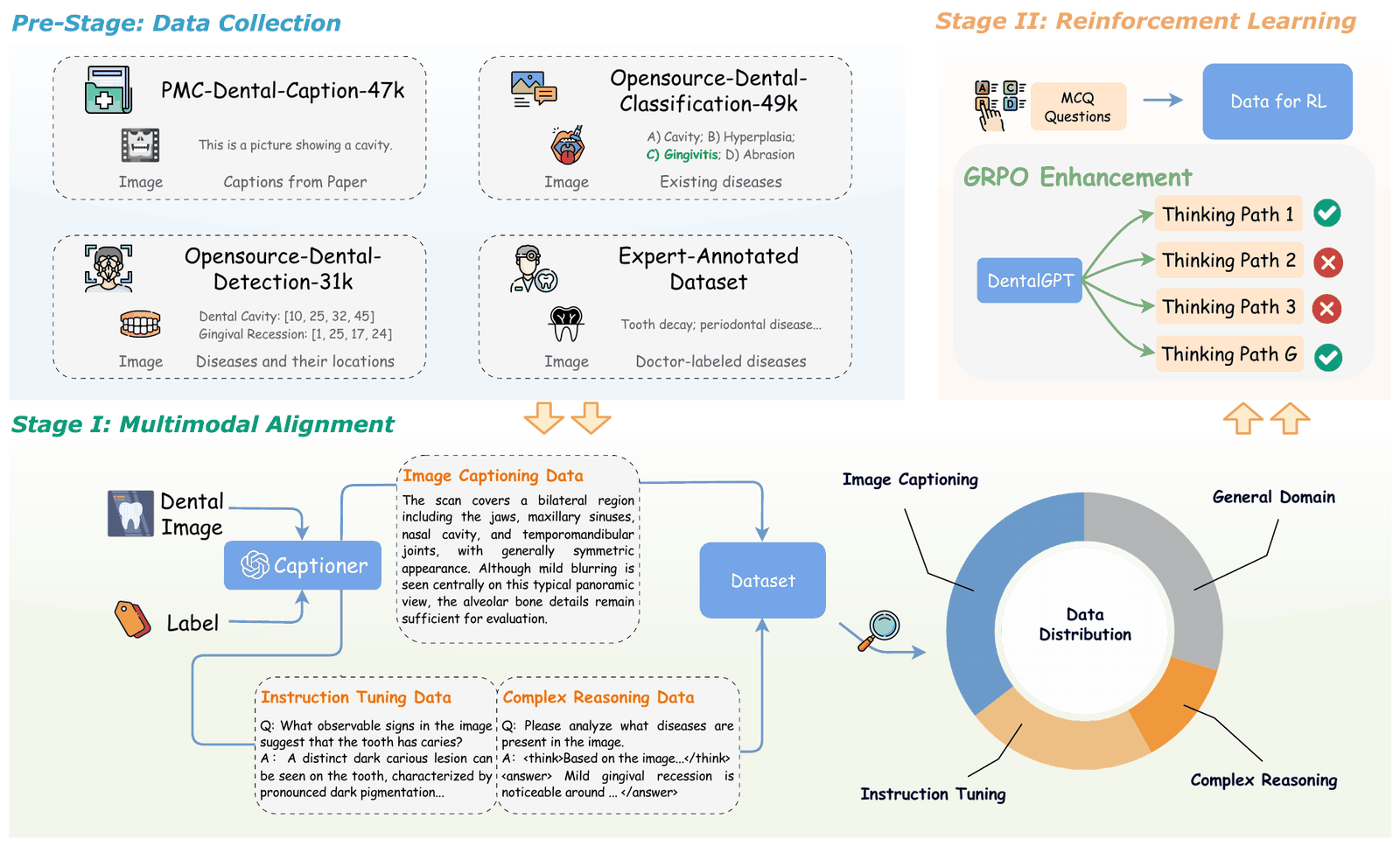 Figure 1: How DentalGPT is built: data collection, stage 1 multimodal alignment and stage 2 reinforcement learning. Source: the paper
Data: more than 120,000 dental images
The team gathered intraoral photos, panoramic radiographs and partial panoramic radiographs from multiple sources. The paper describes this as the largest annotated multimodal dental dataset to date. It has four main parts:
- PMC-Dental-Caption-47k: dental images and their original captions selected from PubMed Central papers;
- Opensource-Dental-Classification-49k: several open-source classification datasets combined, with disease labels for each image;
- Opensource-Dental-Detection-31k: from lesion localization datasets, with bounding boxes for teeth and lesions;
- Expert-annotated data: from the web, hospital image archives and public datasets, annotated by professional dentists; annotations with cross-validation agreement below 85% were filtered out.
Stage 1: multimodal alignment
Using the original labels and descriptions as references, the team had GPT-5 generate observational captions that "describe only visible features and make no diagnostic assumptions", helping the model map visual details to dental concepts. They also built question-answer data that simulates real diagnostic scenarios, complex reasoning (chain-of-thought) data generated with the HuatuoGPT-o1 method, and mixed in general-domain data to preserve the model's general understanding. All data was then double-checked by GPT-5-mini; samples inconsistent with the original descriptions or labels were removed, and more than 90% of every data type was retained.
Stage 2: reinforcement learning
The team selected dental images not used in stage 1 and generated about 10,000 automatically gradable multiple-choice questions from their original labels, training with GRPO (Group Relative Policy Optimization). For each question, 10 responses are sampled; the model first writes out its reasoning and then gives its answer. The reward combines answer correctness (90%) and format compliance (10%), and the response length limit is 8,192 tokens, leaving room for long reasoning chains.
Experiments: a 7B model with higher average accuracy than GPT-5
The evaluation covers five benchmarks: MMOral-OPG-Bench, a question-answering benchmark on panoramic radiographs; a dental subset of medical VQA, made up of dental samples selected from PMC-VQA, OmniMedVQA and MedXpertQA-MM; and three classification benchmarks annotated and cross-validated by dentists: Intraoral-Classification-I (300 cases, intraoral photos taken to clinical standards), Intraoral-Classification-II (206 cases, intraoral selfies posted online by patients) and Panorama-Classification (156 cases, panoramic radiographs collected in hospitals).
| Model | MMOral-OPG | Medical VQA (dental subset) | Intraoral I | Intraoral II | Panoramic classification | Average |
|---|---|---|---|---|---|---|
| Qwen2.5-VL-7B-Instruct (base) | 27.0 | 46.1 | 48.8 | 61.8 | 50.0 | 46.7 |
| HuatuoGPT-Vision | 36.3 | 38.5 | 55.2 | 51.2 | 53.8 | 47.0 |
| MedGemma-27B-it | 50.6 | 41.8 | 52.6 | 56.2 | 61.0 | 52.4 |
| Claude-Sonnet-4.5-Thinking | 50.3 | 53.9 | 55.2 | 66.7 | 55.8 | 56.4 |
| Gemini-2.5-Pro-Thinking | 45.7 | 57.4 | 57.0 | 65.2 | 64.1 | 57.9 |
| LLaMA-4-Maverick | 51.4 | 53.9 | 61.1 | 67.1 | 59.0 | 58.5 |
| GPT-5 | 47.7 | 54.3 | 59.3 | 71.0 | 63.5 | 59.2 |
| DentalGPT | 60.0 | 54.4 | 64.1 | 72.9 | 84.0 | 67.1 |
Table: Accuracy (%) on five dental benchmarks, excerpted from Table 3 of the paper; the best score in each column is in bold. GPT-5, models with the Thinking suffix and DentalGPT were evaluated with complex reasoning mode enabled.
Key points:
- DentalGPT's average accuracy of 67.1% is 7.9 percentage points above GPT-5 and 20.4 points above its base model.
- It scores highest on all three expert-annotated benchmarks, reaching 84.0% on panoramic classification, against 50.0% for the base model and 63.5% for GPT-5.
- It leads MMOral-OPG-Bench with 60.0%; on the medical VQA dental subset it scores 54.4%, second only to Gemini-2.5-Pro-Thinking at 57.4%.
- The medical multimodal models HuatuoGPT-Vision and MedGemma-27B-it average 47.0% and 52.4% respectively, showing that general medical models are also limited on oral-health tasks.
The paper notes that at 7B parameters, DentalGPT matches or exceeds many general-purpose models with more than 100 billion parameters.
What dentists think
The team also invited 4 practicing dentists to take part in the evaluation. They selected 80 dental images from medical textbooks and dental licensing exams and asked each model to identify every possible oral problem in the image. The dentists then compared DentalGPT's answers with those of the other models pairwise, looking at obvious errors, the soundness of the diagnosis and omissions of key information (Figure 2). Against GPT-5 and Gemini-2.5 Pro, DentalGPT won 28.3% and 30.0% of comparisons and lost 16.7% and 21.7%, with the rest tied; against Claude Sonnet-4.5 and Qwen3-VL-235B, its win rates were 63.9% and 87.5%.
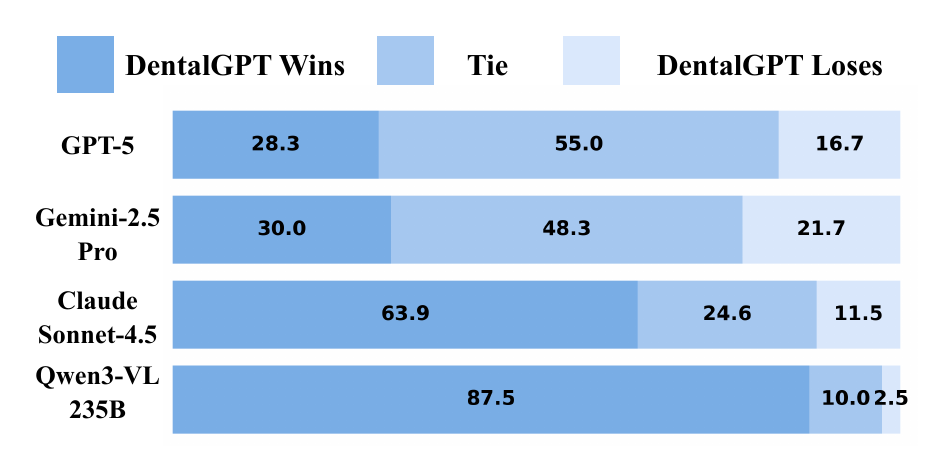 Figure 2: Pairwise evaluation by practicing dentists; Win, Tie and Loss are the shares (%) of DentalGPT wins, ties and losses. Source: the paper
What each stage contributes
Ablation experiments show that stage 1 multimodal alignment alone raises the average accuracy across the five benchmarks from 46.7% to 63.2%; adding reinforcement learning lifts it further to 67.1%, with gains on all five benchmarks, including panoramic classification rising from 78.4% to 84.0%.
The team also compared models trained with 0%, 30% and 100% of the stage 1 data in the subsequent reinforcement learning: for the model without dental alignment, reinforcement learning brought only limited reward gains, and the more alignment data, the higher the ceiling reinforcement learning could reach (Figure 3). The paper argues that multimodal alignment gives reinforcement learning a richer space to explore, further eliciting complex reasoning in dentistry.
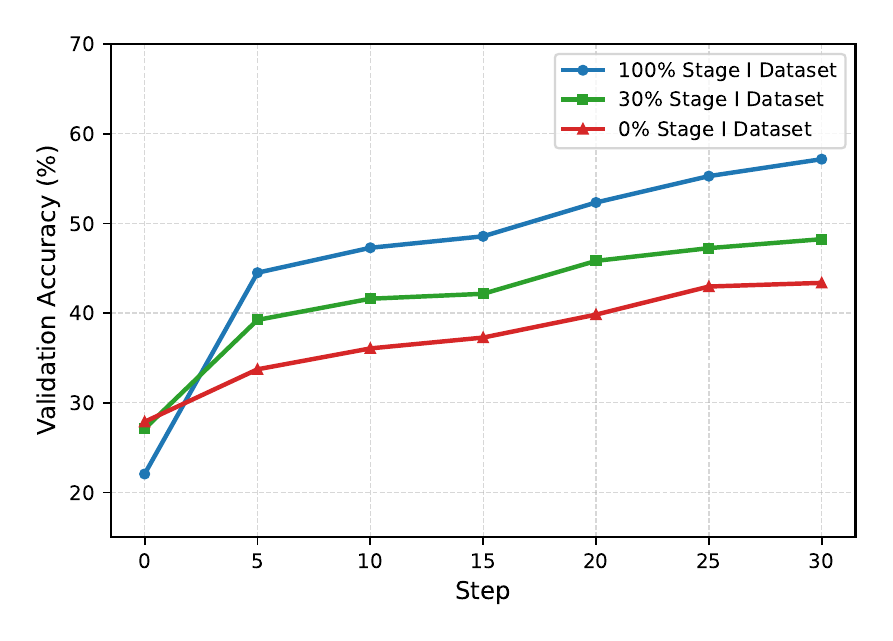 Figure 3: Validation accuracy (reward) during reinforcement learning with different shares of stage 1 data. Source: the paper
Back to the filling-counting example: the base model answered 0; after stage 1, the model recognized most of the filled teeth and counted 9; the fully trained DentalGPT, with complex reasoning enabled, also miscounted along the way, but after repeated checking arrived at the correct answer of 10.
Significance and outlook
DentalGPT's results show that high-quality dental data combined with staged training, "align first, then reinforce", can give a 7B model strong performance on oral image understanding and question answering.
The paper is also clear about its limitations: high-quality annotated dental data remains scarce, and data construction that relies on expert annotation and manual work is costly and hard to scale, so more efficient forms of human–AI collaboration need to be explored. The authors also stress that DentalGPT is not currently intended for direct clinical use; real-world deployment requires further adaptation and rigorous validation, and clinical decisions should be overseen by qualified professionals.
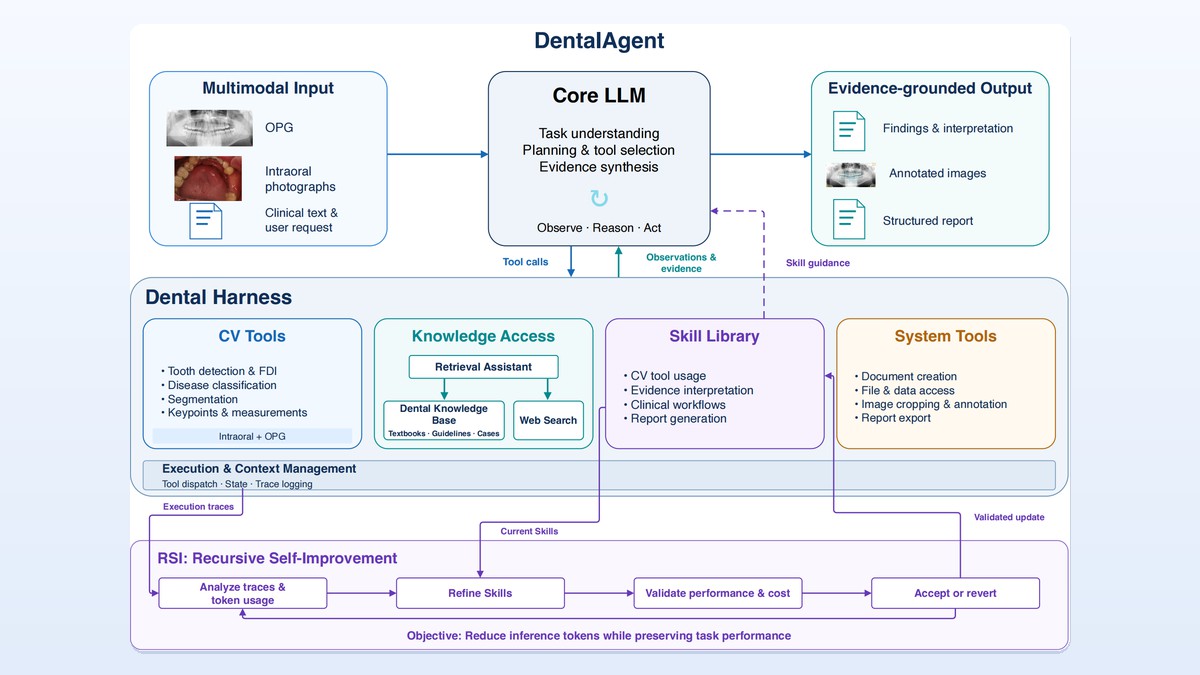
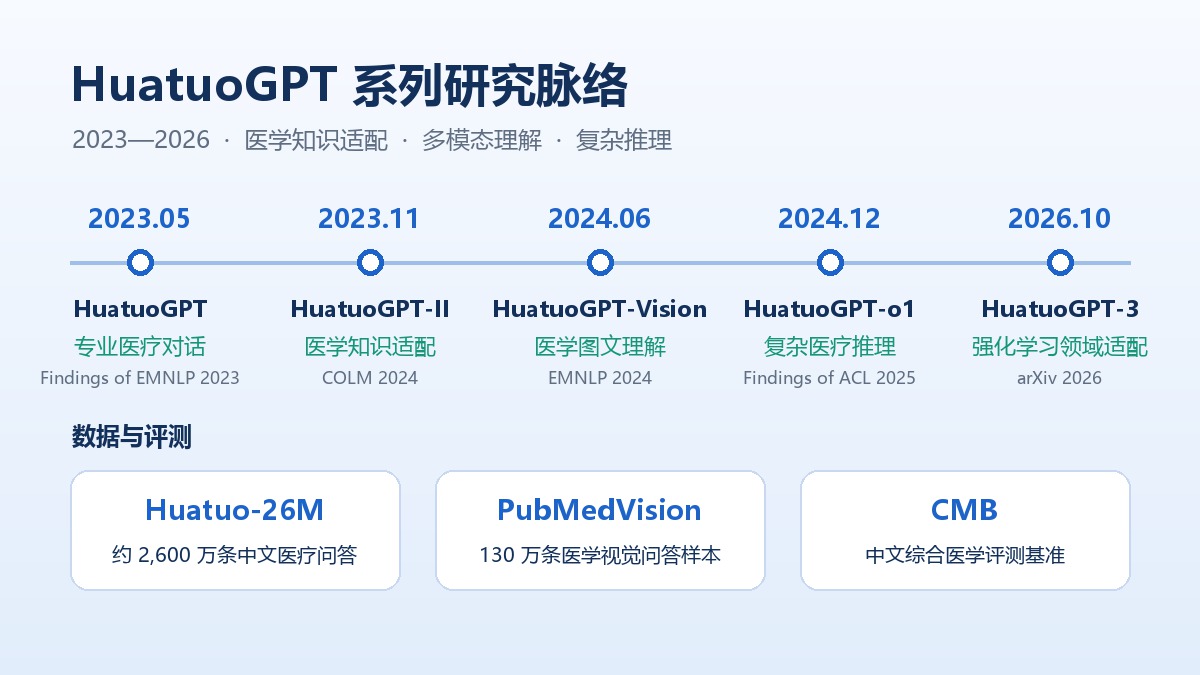
At FreedomAI, DentalGPT serves as the specialist model and research foundation for oral-health applications. It builds on the medical large-model methods the team developed in the HuatuoGPT series; its complex reasoning data, for instance, follows the HuatuoGPT-o1 approach.
The team
DentalGPT is the result of a collaboration among several institutions. The co-first authors are Zhenyang Cai (The Chinese University of Hong Kong, Shenzhen), Jiaming Zhang (Shenzhen Stomatology Hospital (Pingshan) of Southern Medical University) and Junjie Zhao (Faculty of Dentistry, The University of Hong Kong; Beijing Institute of Collaborative Innovation). The corresponding authors are Liangyi Chen (Peking University), Junwen Wang (Faculty of Dentistry, The University of Hong Kong), Shan Jiang (Shenzhen Stomatology Hospital (Pingshan) of Southern Medical University) and Benyou Wang (The Chinese University of Hong Kong, Shenzhen, and others).
Several FreedomAI core members took part in this research: CTO Zhenyang Cai, a PhD student at The Chinese University of Hong Kong, Shenzhen, who contributed to models including HuatuoGPT-o1 and DentalGPT; COO Junjie Zhao, a PhD candidate in a joint program of the HKU Faculty of Dentistry and Peking University, who works on multimodal dental large models; Chief Medical Scientist Junwen Wang, a tenured professor at the HKU Faculty of Dentistry; and Chief AI Scientist Benyou Wang, an assistant professor and doctoral supervisor at the School of Data Science, The Chinese University of Hong Kong, Shenzhen. CEO Jianquan Li and Vice President of Medical Products Xiangyi Feng are also authors of the paper.