ICLR 2026 | بمشاركة Zhenyang Cai، المدير التقني لـ FreedomAI: نموذج MicroVerse يكشف «النقاط العمياء المجهرية» لنماذج الفيديو عبر 459 مهمة
هذه المقالة غير متوفرة بالعربية بعد، وفيما يلي النسخة الإنجليزية.
Video generation models have advanced rapidly in the past two years. They can generate street scenes, people and moving objects that pass for real, and researchers have begun treating them as "world simulators" to help robots learn skills and agents explore environments.
But almost all of this progress has happened at the macroscopic scale visible to the naked eye. Zoom in to alveoli, cells or even molecules, and things change: the generated footage "looks the part", but the processes don't hold up to scrutiny. In cases shown in the paper, Sora and Veo3 both violated physical or biological laws when simulating alveoli, cell division and DNA-related processes.
To fill this gap, researchers from The Chinese University of Hong Kong, Shenzhen, Peking Union Medical College Hospital and Shenzhen Loop Area Institute introduce the concept of "Micro-World Simulation" and present a complete proof of concept: the MicroWorldBench benchmark, the expert-verified MicroSim-10K dataset, and MicroVerse, a micro-scale video generation model trained on it. The paper has been accepted to ICLR 2026 (Poster). FreedomAI CTO Zhenyang Cai is one of the authors, and FreedomAI Chief AI Scientist Benyou Wang is the corresponding author.
Paper: MicroVerse: A Preliminary Exploration Toward a Micro-World Simulation
Link: https://arxiv.org/abs/2603.00585
Code: https://github.com/FreedomIntelligence/MicroVerse
Dataset: https://huggingface.co/datasets/wangrongsheng/MicroVerse
Authors: Rongsheng Wang*, Minghao Wu*, Hongru Zhou, Zhihan Yu, Zhenyang Cai, Junying Chen, Benyou Wang† (* co-first authors, † corresponding author)
Affiliations: The Chinese University of Hong Kong, Shenzhen; Peking Union Medical College Hospital; Shenzhen Loop Area Institute
Background: world models' blind spot is the micro scale
Micro-scale simulation tracks the interactions between atoms, molecules and cells and is an important way to understand the mechanisms behind life processes. The paper notes its broad promise in biomedical settings such as drug discovery, organs-on-chips and research into disease mechanisms, as well as its potential for education and interactive visualization.
The problem is that existing video models are trained mainly on human-scale video and lack grounding in micro-scale physics and biomedical knowledge. The authors frame this work as an exploration of "educational micro-scale simulation of biological mechanisms", not a replication of wet-lab results.
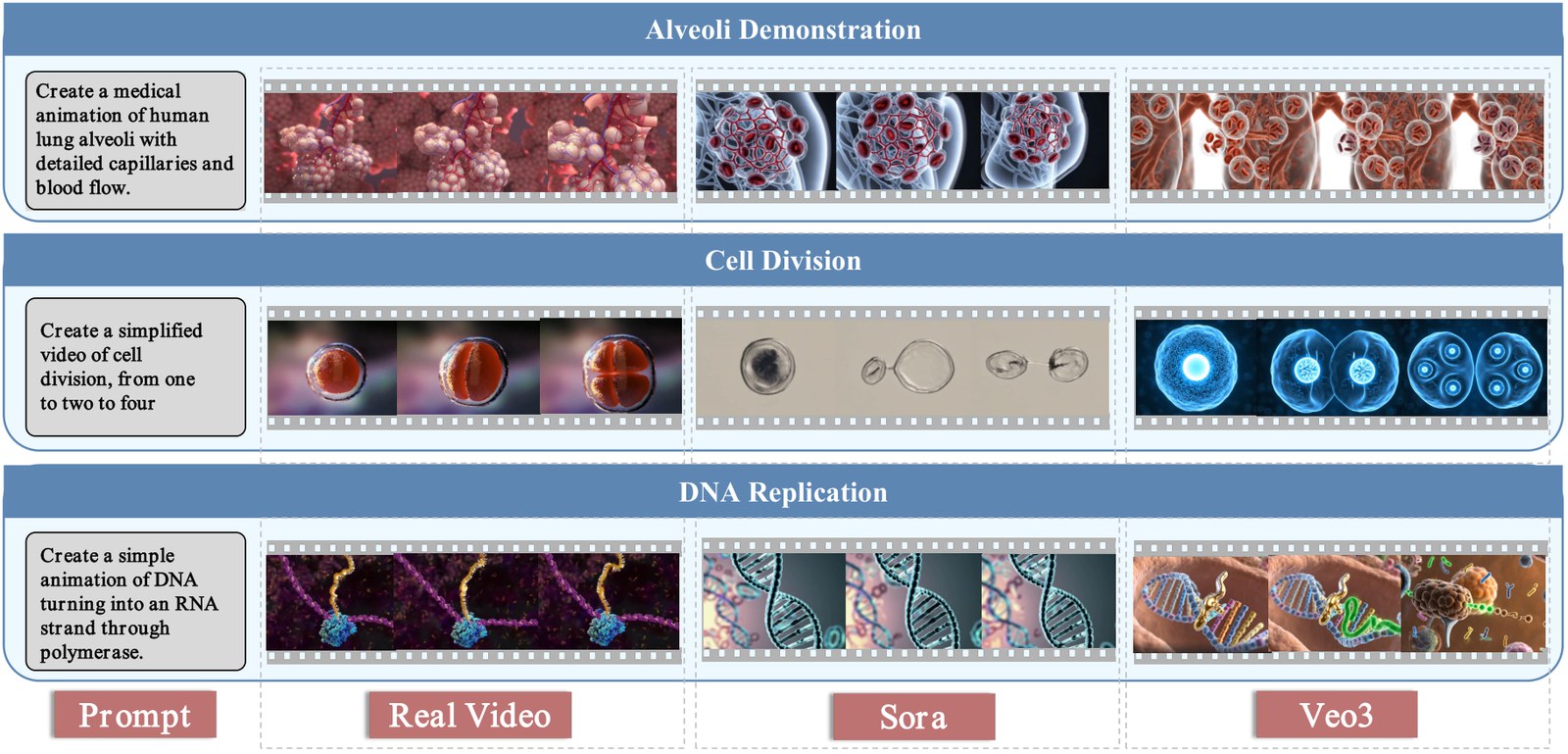 Figure 1: Failure cases of Sora and Veo3 in micro-scale simulation. The three rows show alveoli, cell division and DNA-related processes; from left to right: the prompt, real video, and results from Sora and Veo3 (source: the paper)
Method 1: MicroWorldBench, scoring rubrics for micro-scale video
Existing video evaluations mostly use generic scoring rules, which struggle to catch videos that "look good but get the mechanism wrong". MicroWorldBench writes a separate weighted rubric for each task, putting first the scientific points experts consider most critical.
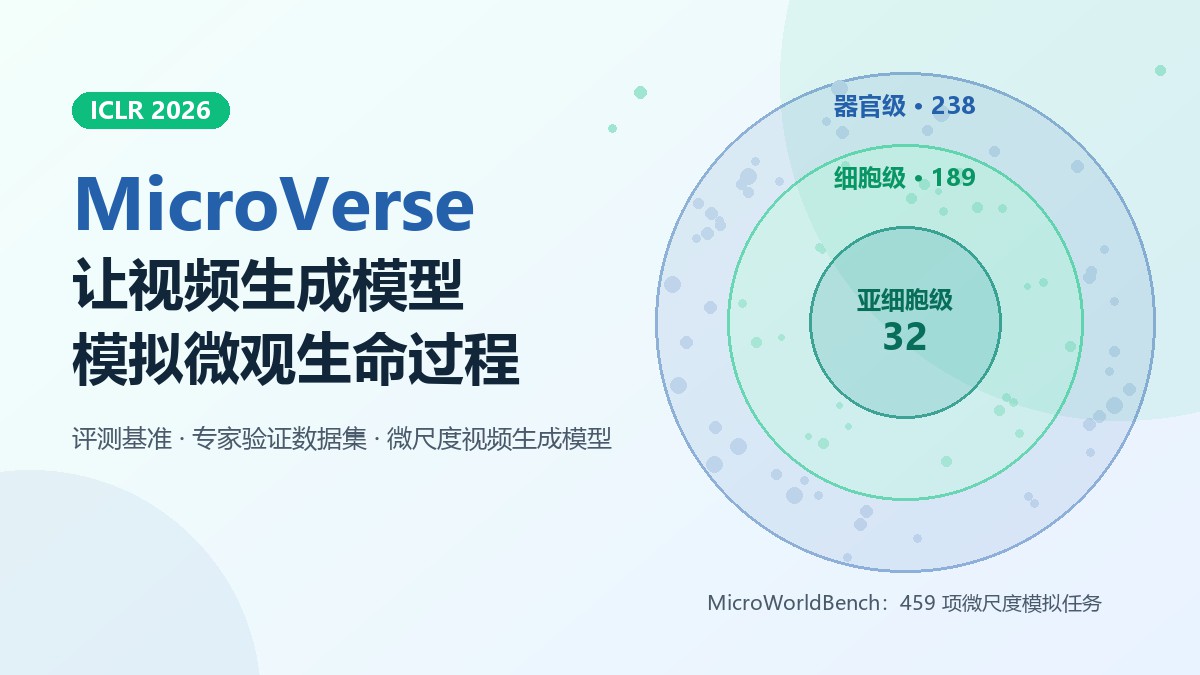
Where the tasks come from. The researchers searched more than 8,000 YouTube videos on topics at three levels, organ, cell and subcellular. GPT-4o generated 8,162 candidate tasks from the titles and descriptions, which three biology experts then screened (each task needed approval from at least two experts), leaving 459 tasks: 238 at the organ level, 189 at the cell level and 32 at the subcellular level.
How the rubrics are set. For each task, GPT-5 first drafts a set of scoring items. Each item specifies an evaluation dimension (scientific fidelity, visual quality or instruction following), a concrete description, whether it adds or deducts points, and a weight (1.0 for core scientific requirements, 0.5 for important but secondary ones, 0.2 for supporting or presentational ones). Three experts with PhDs and 8 to 12 years of experience in cell and molecular biology then independently revised them, removing redundant items, adjusting weights and adding missing scientific constraints, before merging their versions through discussion and majority vote. The final score is normalized to 100 against the full marks of all positive items, so that minor bonus items cannot offset serious scientific errors.
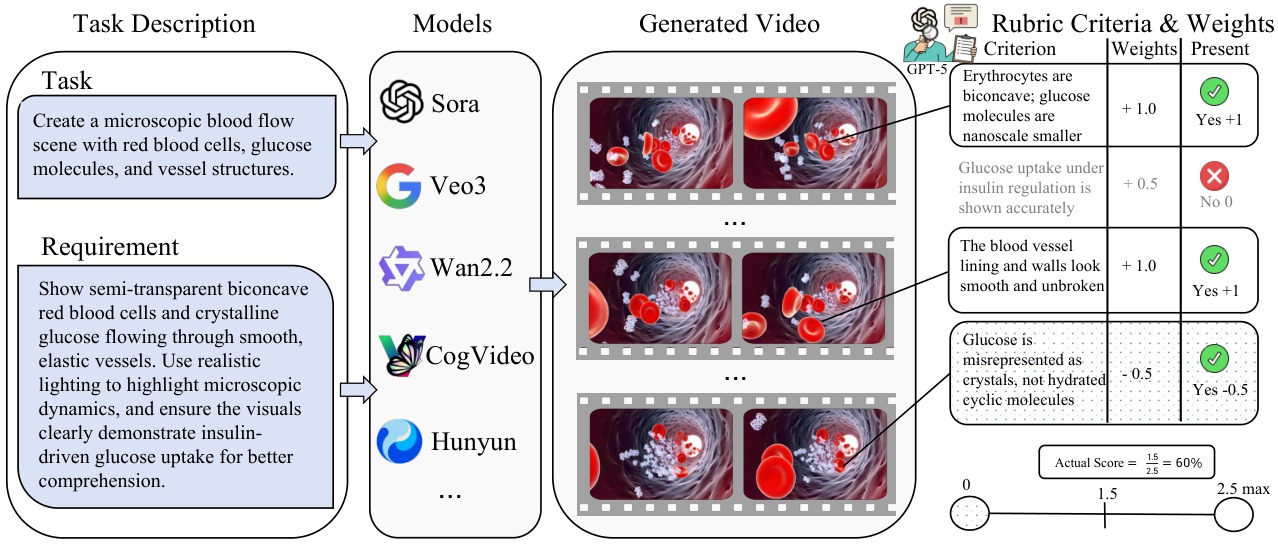 Figure 2: An example of the MicroWorldBench evaluation process: the task asks for a micro-scale blood flow scene with red blood cells, glucose molecules and a blood vessel; the scoring system checks each expert-revised item in turn, and the example video scores 1.5/2.5, or 60% (source: the paper)
The experts' revisions were logged: only about 7.6% of tasks needed experts to add missing scientific items, and the smaller the scale, the more experts intervened, averaging 1.52 revisions per task at the organ level, 3.00 at the cell level and 5.50 at the subcellular level. GPT-5 serves as the judge. Spot checks show an agreement coefficient (Fleiss' κ) of 0.733 among human experts alone and 0.771 with GPT-5 included; the Spearman correlation between GPT-5's and Gemini-2.5-pro's scores is 0.835.
Findings: realistic visuals, distorted mechanisms
The researchers evaluated open-source models including HunyuanVideo, CogVideoX and the Wan2.1 / Wan2.2 series, along with two commercial models, Sora and Veo3, on MicroWorldBench, running each model once with default settings.
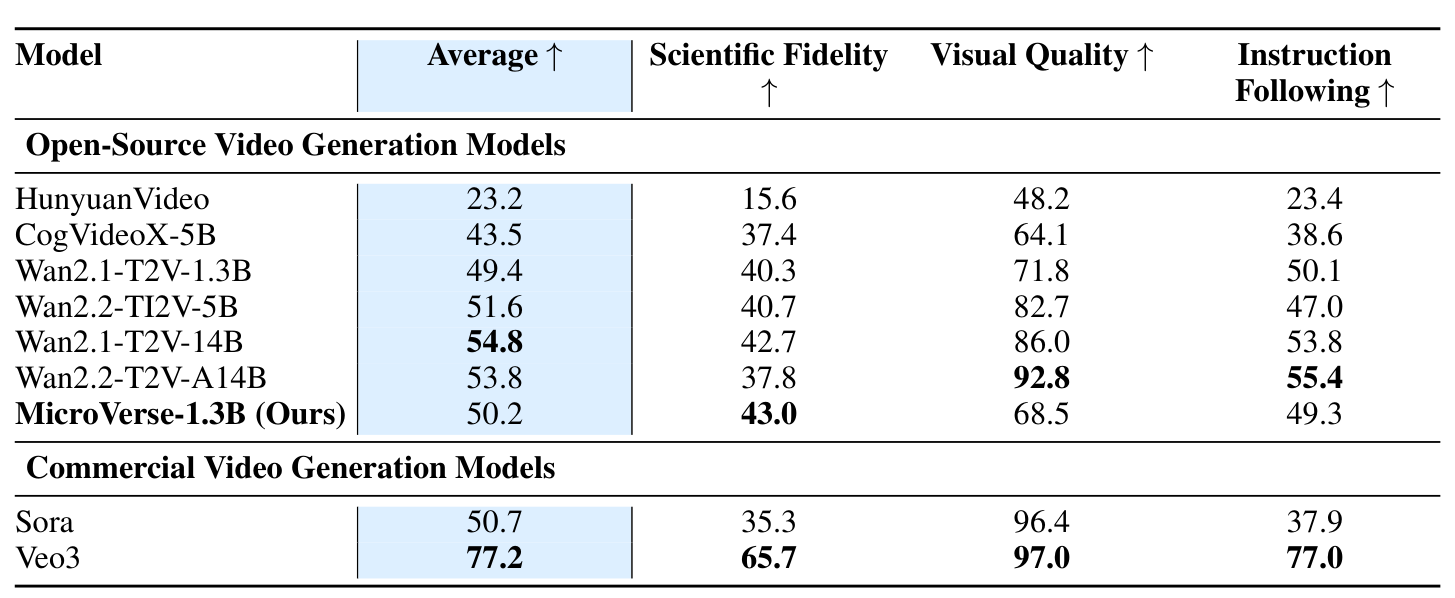 Figure 3: Scores by dimension for each video generation model on MicroWorldBench (source: Table 2 of the paper)
The results reveal three patterns:
- High visual quality, low scientific fidelity. Wan2.2-T2V-A14B, Sora and Veo3 all score above 92 on visual quality, but lag clearly on scientific fidelity: apart from Veo3 (65.7), every model evaluated scores between 15.6 and 43.0. Sora scores 96.4 on visual quality but only 35.3 on scientific fidelity.
- The smaller the scale, the harder it gets. Wan2.2-T2V-A14B, for example, scores 56.3 at the organ level and 52.0 and 53.3 at the cell and subcellular levels; Sora's cell-level score (46.1) is also clearly below its organ-level score (55.9). The authors attribute this to the stricter physical and biological consistency micro-scale tasks demand and the scarcity of training data.
- More parameters alone are not enough. In the Wan2.1 series, scaling from 1.3B to 14B raises visual quality from 71.8 to 86.0 but scientific fidelity only from 40.3 to 42.7.
Method 2: MicroSim-10K and MicroVerse
To fill in "micro-scale common sense", you first need the right data. The researchers searched for micro-scale simulation videos through the official YouTube API, keeping only videos at 720p or higher under Creative Commons licenses, 12,848 in total. Using OpenCLIP similarity between adjacent frames, they cut these into 67,853 semantically coherent clips and filtered them in stages:
- A classifier trained on VideoMAE (over 92% accuracy) removed 34,318 clips unrelated to micro-scale simulation;
- OpenCV detection of black borders and EasyOCR detection of subtitles removed 6,694 and 14,647 clips respectively;
- Expert review removed another 2,593 meaningless or physically inconsistent clips.
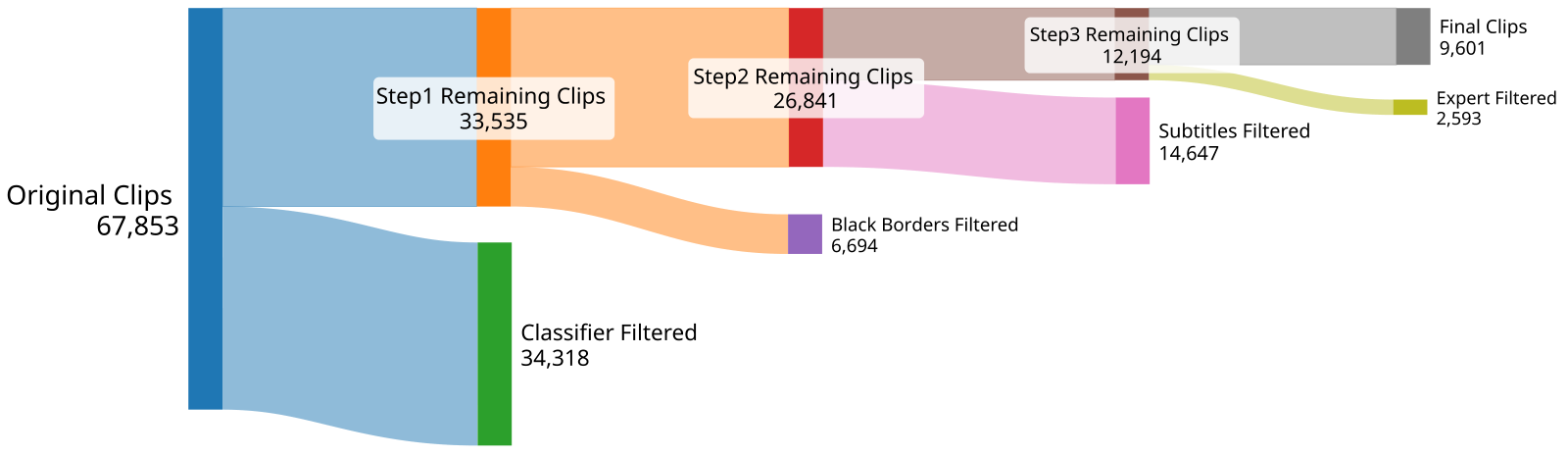 Figure 4: The MicroSim-10K data filtering pipeline, narrowing 67,853 raw clips down to 9,601 (source: the paper)
The final MicroSim-10K contains 9,601 expert-verified video clips of 5 to 60 seconds each. For each clip, GPT-4o generated a description of about 150 words on average from 8 uniformly sampled frames and the original video's title and description, which experts then checked. To rule out data leakage, the researchers deduplicated at the level of video IDs, text and frames; after further removing 14 evaluation tasks that might be similar, MicroVerse's average score changed from 50.2 to 50.0, essentially unaffected.
On the model side, MicroVerse is based on Wan2.1-T2V-1.3B and was fully fine-tuned on MicroSim-10K for 5,000 steps on 8 NVIDIA H200 GPUs, generating 81-frame videos at 480×832. During training, the text condition was dropped with 10% probability to support classifier-free guidance (CFG).
Results: the best scientific fidelity of all open-source models evaluated
On MicroWorldBench, MicroVerse-1.3B scores 43.0 on scientific fidelity, 2.7 points above its base, Wan2.1-T2V-1.3B (40.3), and above the larger Wan2.1-T2V-14B (42.7), the highest of all open-source models evaluated. On the highly challenging subcellular tasks it scores 53.3, tying Wan2.2-T2V-A14B for first among open-source models. The cost is a slight drop in visual quality (71.8 to 68.5) and instruction following (50.1 to 49.3), which the paper considers acceptable given the core goal of improving scientific fidelity. A clear gap remains to commercial models: Veo3 scores 65.7 on scientific fidelity.
To address the limited gains and slightly lower visual quality of the small model, the researchers scaled up the model and mixed in an equal amount of general high-quality video (randomly sampled from OpenVid) during training:
| Base model | Training data | Scientific fidelity | Visual quality | Instruction following |
|---|---|---|---|---|
| Wan2.1-1.3B | No fine-tuning | 40.3 | 71.8 | 50.1 |
| Wan2.1-1.3B | MicroSim-10K | 43.0 | 68.5 | 49.3 |
| Wan2.1-1.3B | General data + MicroSim-10K | 44.1 | 74.4 | 53.8 |
| Wan2.1-14B | No fine-tuning | 42.7 | 86.0 | 53.8 |
| Wan2.1-14B | MicroSim-10K | 45.4 | 82.7 | 51.4 |
| Wan2.1-14B | General data + MicroSim-10K | 48.3 | 87.7 | 56.9 |
The figures in the table come from Table 4 of the paper. "A larger model plus mixed data" raises the 14B model's scientific fidelity to 48.3 (5.6 above its base), with visual quality and instruction following improving as well; the paper reports this as state of the art among open-source models.
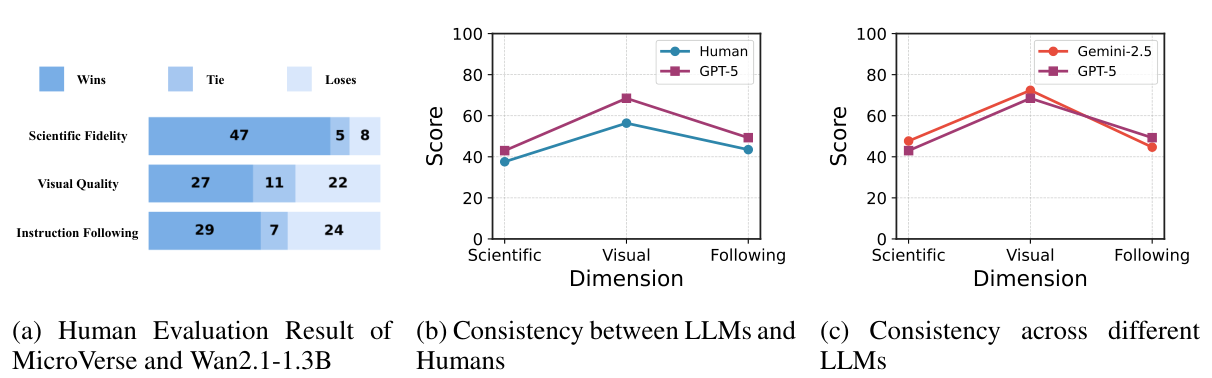 Figure 5: (a) Human evaluation of MicroVerse versus its base Wan2.1-1.3B; (b) (c) scoring agreement between LLM judges and humans and between different LLM judges (source: the paper)
Human evaluation confirms this. The researchers built 60 sample pairs across the three levels (20 per level); with model outputs randomly shuffled, three raters chose the better of MicroVerse and its base Wan2.1-1.3B or called a tie. On scientific fidelity, MicroVerse won 47 pairs, tied 5 and lost 8; pairwise agreement between the three raters (Cohen's κ) ranged from 0.81 to 0.87.
Ablations also show the role of data quality: fine-tuning on the raw, uncleaned data (34,318 clips) gave a scientific fidelity of 42.1 and instruction following of 44.5; switching to the 9,601 cleaned clips gave 43.0 and 49.3, with less data and more balanced results.
Significance and outlook
The paper describes this as the first work to propose the concept of "micro-world simulation", presenting a complete proof of concept with a clear goal, a dedicated benchmark, training data and a purpose-built model, with potential uses in biological research, education and scientific visualization.
The authors are also clear about its limits: the current approach does not yet explicitly incorporate the physical laws that govern micro-scale dynamics, such as fluid dynamics in blood flow, diffusion–reaction equations in molecular transport and biomechanical constraints in cellular processes, so it is not yet suitable for settings that require high-precision scientific simulation and prediction. The evaluation tasks are currently drawn from YouTube, and the team plans to expand the evaluation with professional microscopy imaging databases.
The MicroWorldBench evaluation code and MicroVerse training code are open source on GitHub, and the dataset of about 9.6k samples has been released on Hugging Face.
The team
- Zhenyang Cai: fifth author, affiliated with The Chinese University of Hong Kong, Shenzhen. He is a PhD student there and FreedomAI's CTO, leading multimodal medical model development; he has contributed to models including HuatuoGPT-o1 and DentalGPT and published first-author papers at NeurIPS and ACL.
- Benyou Wang: corresponding author, assistant professor and doctoral supervisor at the School of Data Science, The Chinese University of Hong Kong, Shenzhen, and FreedomAI Chief AI Scientist.
- The co-first authors are Rongsheng Wang and Minghao Wu; the other authors include Hongru Zhou (Peking Union Medical College Hospital), Zhihan Yu and Junying Chen. The paper's affiliations are The Chinese University of Hong Kong, Shenzhen, Peking Union Medical College Hospital and Shenzhen Loop Area Institute.