Foshan public hospital reform and high-quality development demonstration project | FreedomAI and Foshan Stomatological Hospital build AI-assisted diagnosis for endodontic diseases in three steps
Diagnosing endodontic diseases (including dental caries, pulp diseases and periapical diseases) means weighing the patient's symptoms, clinical examination and imaging evidence together, and expert experience plays a key role. How can that experience be captured as a basis AI can learn from, so that primary care can also get evidence-based diagnostic support?
The "AI-assisted diagnosis of endodontic diseases" project, a collaboration between Foshan Stomatological Hospital and FreedomAI, is built around exactly this question. It is a 2026 Foshan demonstration project for public hospital reform and high-quality development and has three parts: case data governance, expert knowledge and model building, and development of diagnostic support applications for primary care (Figure 1). It makes clear that the dentist makes the final decision.
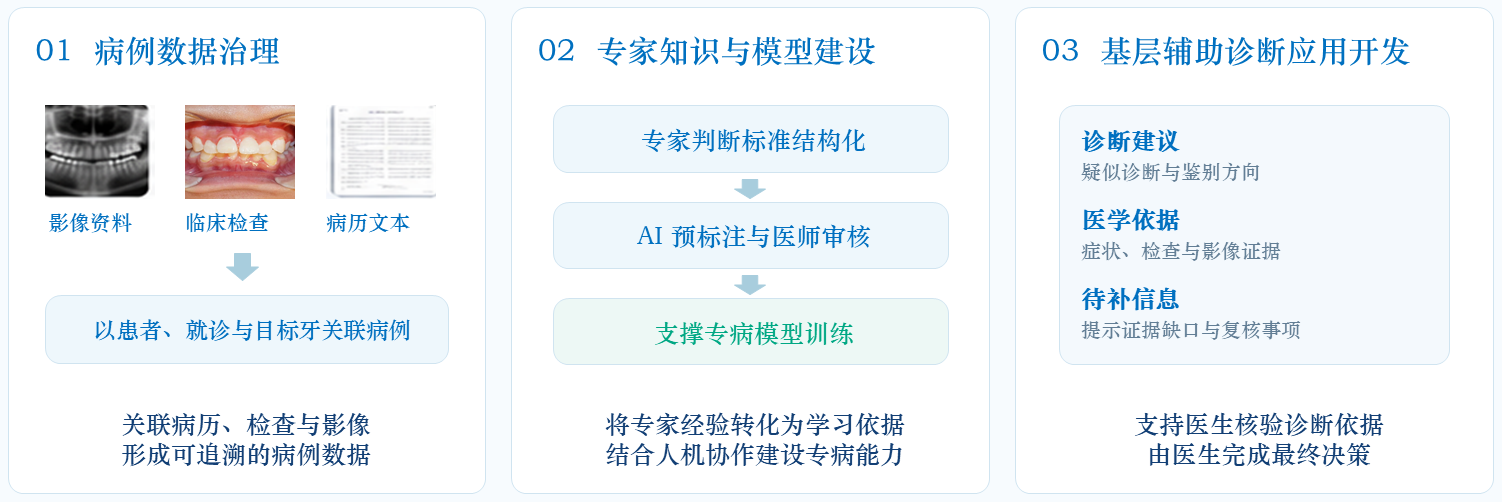 Figure 1: The three parts of the project on AI-assisted diagnosis of endodontic diseases (source: FreedomAI)
Step 1: case data governance, so every case can be traced
Specialist AI starts with getting the data in order. The project brings together three kinds of data, imaging, clinical examinations and medical record text, and links cases along the thread of "patient – visit – target tooth" (the target tooth being the specific tooth a treatment addresses). This ties records, examinations and images together into traceable case data.
Step 2: expert knowledge and model building, turning experience into a basis for learning
The second step addresses "what to teach the model". The project first structures the experts' diagnostic criteria, then processes the data by combining AI pre-annotation with review by dentists: the AI produces initial annotations, which dentists then review and approve, and the results are used to train the specialist model.
Through this process, expert experience becomes the basis for the model's learning, and specialist capabilities are built up step by step through human–AI collaboration.
Step 3: diagnostic support applications for primary care, with suggestions and the evidence behind them
For primary care settings, the diagnostic support application developed in the project outputs three kinds of information:
- Diagnostic suggestions: suspected diagnoses and differential directions (that is, which similar diseases need to be ruled out);
- Medical evidence: the symptoms, examinations and imaging evidence that support the judgment;
- Missing information: gaps in the evidence and items that need to be rechecked.
The design aims to help dentists verify the basis for a diagnosis: the AI makes suggestions, lists the evidence and points out the gaps, and the dentist makes the final decision.
Human–AI collaboration throughout
Across all three parts, dentists' professional judgment stays at the center. In model building, experts' diagnostic criteria are what the AI learns from, and AI pre-annotations must be reviewed by dentists. In application, the AI provides diagnostic suggestions, medical evidence and missing information, and the dentist verifies the evidence and makes the final decision. The AI organizes information and flags gaps in the evidence, while the authority to diagnose stays with the dentist.
Significance and outlook
In FreedomAI's AI solutions for healthcare institutions, AI-assisted diagnosis for specific diseases sits alongside applications such as intelligent customer service, assisted diagnosis and treatment, medical record quality control and post-visit follow-up, with a focus on identifying specific diseases from medical history and imaging. Through the Foshan project, FreedomAI hopes to build capabilities in specialist data governance, translating expert knowledge and delivering applications, laying the groundwork for extending to more specific diseases and replicating the approach across institutions.
FreedomAI's AI solutions for healthcare institutions have now been deployed at Shenzhen Stomatology Hospital (Pingshan) of Southern Medical University and Foshan Stomatological Hospital.