FreedomAI Core Technology · Findings of ACL 2026

DentalGPT

Dental multimodal large model

Multimodal alignment on 120,000+ dental images, then reinforcement learning for complex reasoning: the 7B DentalGPT reaches 67.1% average accuracy across five dental benchmarks, ahead of GPT-5's 59.2%.

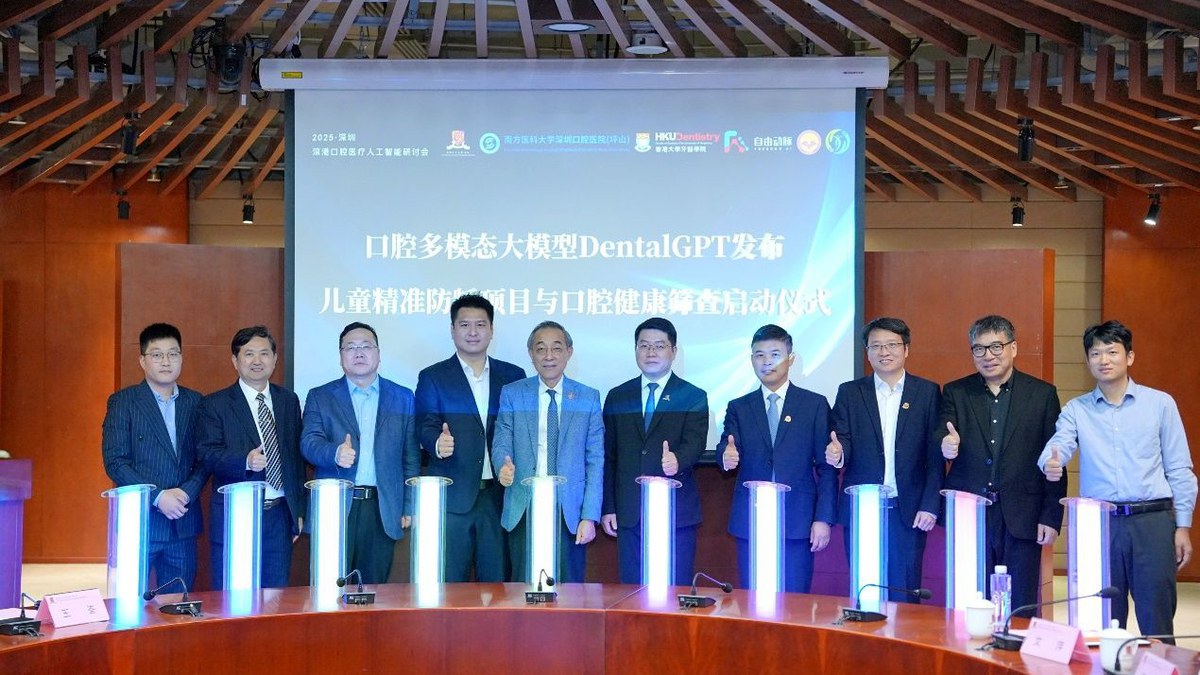
On December 4, 2025, the dental multimodal large model DentalGPT was launched at the Shenzhen–Hong Kong Symposium on AI in Dental Care (Shenzhen)
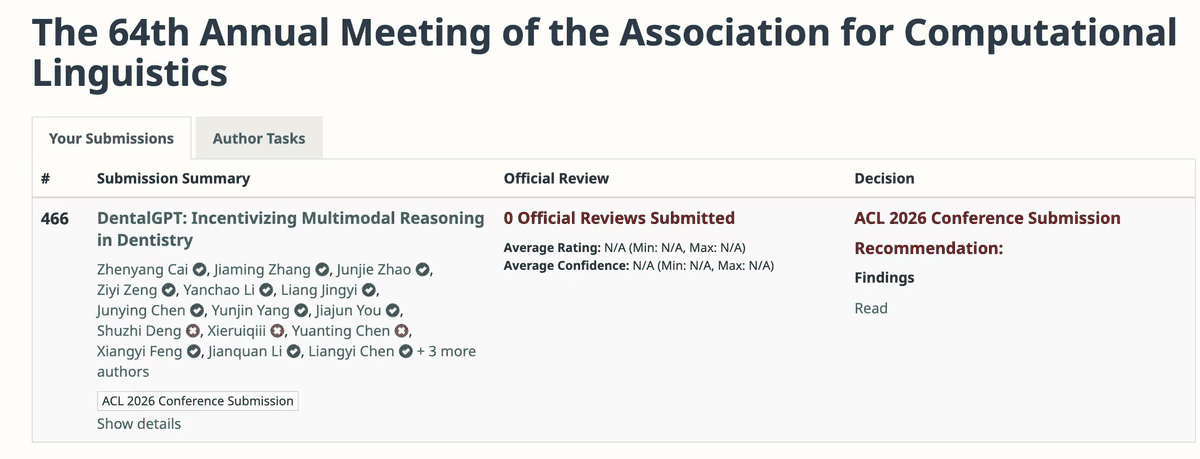
ACL 2026 decision for the DentalGPT paper: Findings
Accepted to Findings of ACL 2026
7Bparameters
120K+annotated dental images
67.1%average accuracy on five dental benchmarks
84.0%panoramic classification accuracy
4licensed dentists in the evaluation

Model: first learn to see, then learn to think

Dental AI faces four hard problems, and DentalGPT tackles each one. Further reading: Benyou Wang, “Why we train a dedicated dental model” →

01

Scarce dental data

In PubMedVision, a large medical image–text dataset, only about 0.3% of images involve teeth.

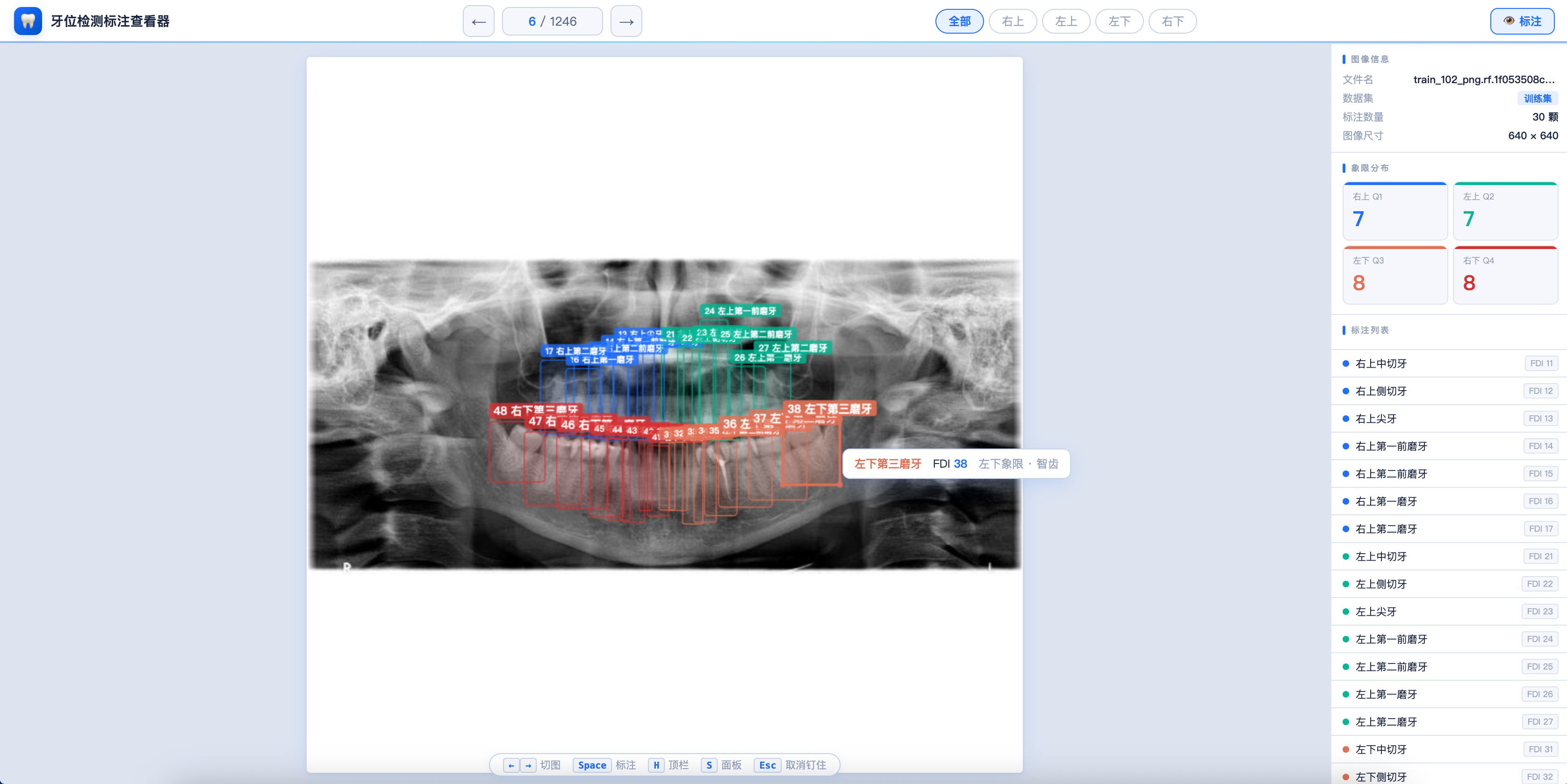
How DentalGPT handles itA specialty dataset of 120,000+ intraoral photos and panoramic radiographs; expert annotations with cross-validated agreement below 85% are filtered out.

02

Fine image details

Fillings, root canal treatments and periapical lesions often occupy a tiny part of a panoramic radiograph; leading general models all score below 60% on a panoramic QA benchmark.

How DentalGPT handles itStage 1, multimodal alignment: observational captions that describe only visible features, so the model links visual details to dental concepts.

03

Complex clinical reasoning

The closer to real cases, the harder it gets: on questions that require individualized reasoning, 12 frontier models average only 35.71%.

How DentalGPT handles itStage 2, reinforcement learning: GRPO training on about 10,000 automatically graded questions to elicit multi-step reasoning.

04

High safety stakes

Among frontier models' answers to real cases, 31.01% were judged unsafe and 4.51% could cause irreversible harm.

How DentalGPT handles itMultinational, expert-level benchmarks keep testing the model; DentalAgent provides verifiable evidence, and clinical decisions always stay with dentists.

Training data: 120,000+ dental images

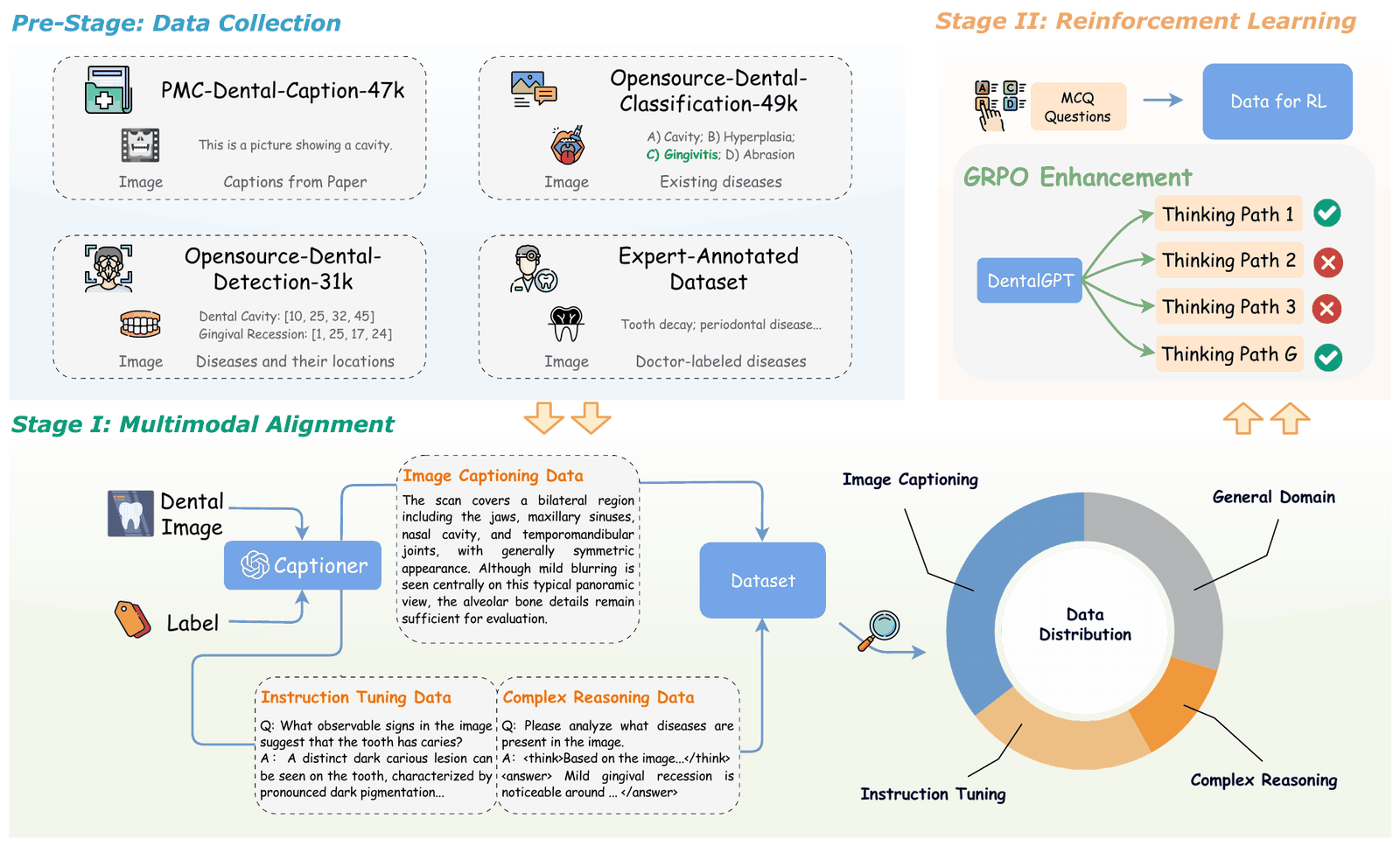
PMC-Dental-Caption-47k

Dental images and their original captions selected from PubMed Central papers.

Opensource-Dental-Classification-49k

Several open-source classification datasets combined, with disease labels for each image.

Opensource-Dental-Detection-31k

From lesion localization datasets, with bounding boxes for teeth and lesions.

Expert-annotated data

From the web, hospital imaging archives and public datasets, annotated by professional dentists; annotations with cross-validated agreement below 85% are filtered out.

Two-stage training

  1. 1
    Stage 1: Multimodal alignment

    Using the original labels as reference, GPT-5 writes observational captions that describe only visible features, without diagnostic assumptions. Q&A simulating diagnostic scenarios and complex-reasoning data built with the HuatuoGPT-o1 method are added and mixed with general data to preserve general abilities. All data is double-checked by GPT-5-mini.

  2. 2
    Stage 2: Reinforcement learning

    Using dental images not seen in Stage 1, about 10,000 automatically gradable multiple-choice questions are generated from the original labels for GRPO training: 10 answers are sampled per question, the reward combines correctness (90%) and format (10%), and answers are capped at 8,192 tokens.

How DentalGPT was built: data collection, Stage 1 multimodal alignment and Stage 2 reinforcement learning (source: paper)

Results: a 7B model with higher average accuracy than GPT-5

Accuracy (%) on five dental benchmarks, excerpted from Table 3 of the paper

ModelMMOral-OPGMedical VQA (dental subset)Intraoral photos IIntraoral photos IIPanoramic classificationAverage
Qwen2.5-VL-7B-Instruct (base)27.046.148.861.850.046.7
HuatuoGPT-Vision36.338.555.251.253.847.0
MedGemma-27B-it50.641.852.656.261.052.4
Claude-Sonnet-4.5-Thinking50.353.955.266.755.856.4
Gemini-2.5-Pro-Thinking45.757.457.065.264.157.9
LLaMA-4-Maverick51.453.961.167.159.058.5
GPT-547.754.359.371.063.559.2
DentalGPT (7B)60.054.464.172.984.067.1

Source: Table 3 of the paper; GPT-5, the Thinking models and DentalGPT were evaluated with complex reasoning enabled

01

67.1% average accuracy

7.9 points higher than GPT-5 (59.2%) and 20.4 points higher than the base model (46.7%).

02

84.0% on panoramic classification

Best on all three classification benchmarks labeled and cross-validated by dentists; on panoramic classification, the base model and GPT-5 score 50.0% and 63.5%.

03

Dentist evaluation

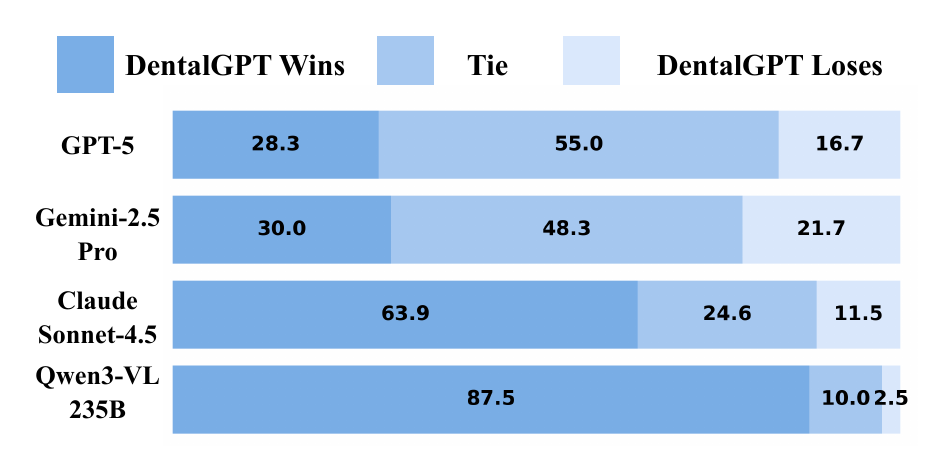
Four licensed dentists compared answers on 80 dental images pairwise: against GPT-5 and Gemini-2.5-Pro, DentalGPT won 28.3% and 30.0% and lost 16.7% and 21.7%; against Claude-Sonnet-4.5 and Qwen3-VL-235B, it won 63.9% and 87.5%.

04

Both stages are essential

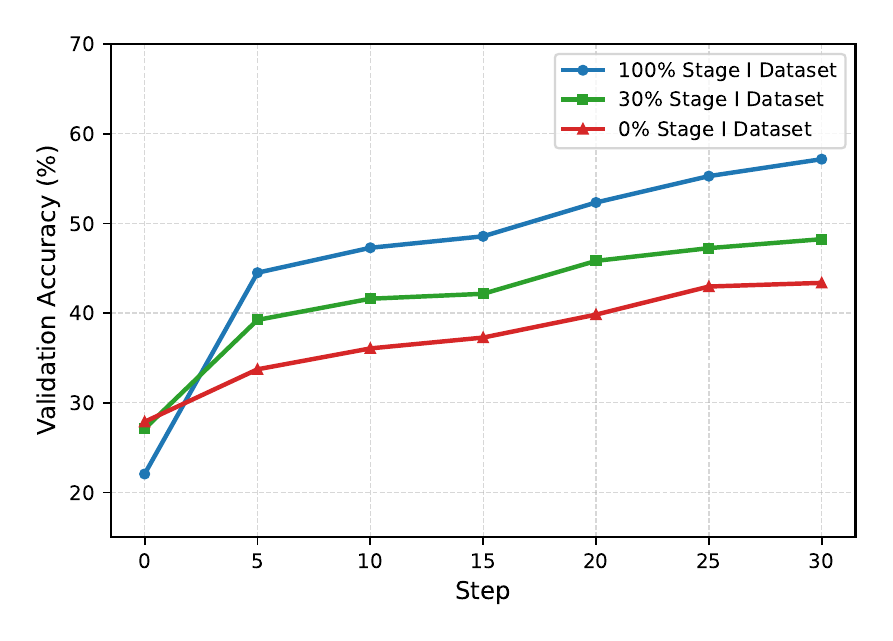
Stage 1 alignment alone lifts average accuracy from 46.7% to 63.2%; adding reinforcement learning brings it to 67.1%. The more alignment data, the higher the ceiling for reinforcement learning.

Pairwise comparison by 4 licensed dentists: share of DentalGPT wins, ties and losses (%) (source: paper)
Validation accuracy during reinforcement learning with different proportions of Stage 1 data (source: paper)

DentalAgent: an agent for professional dental tasks

A large model at the center, combining multimodal input, professional tools and medical knowledge for evidence-based assisted judgments

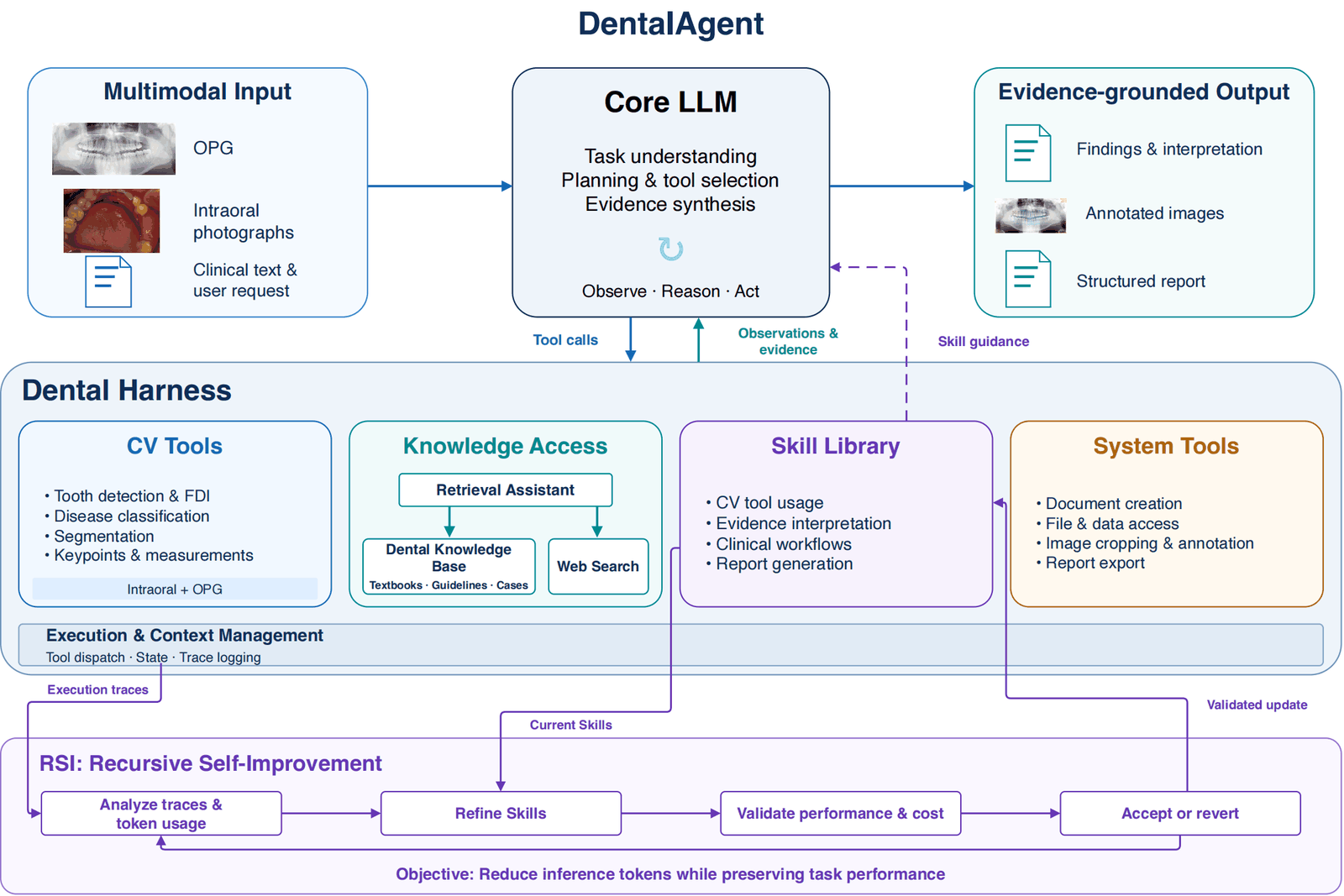
DentalAgent framework: multimodal input, a core large model, a dental task-execution layer and evidence-backed output
01

Professional tool use

Vision tools for tooth detection with FDI numbering, disease classification, segmentation, keypoints and measurement process intraoral photos and panoramic radiographs; the large model plans the call order and integrates the results.

02

Medical evidence support

Searches a dental knowledge base of textbooks, guidelines and cases, and uses tool observations together with retrieved knowledge as evidence to output findings, annotated images and structured reports.

03

Continuous feedback optimization

A recursive self-improvement loop analyzes execution traces and token usage, refines skills and verifies performance and cost, lowering inference cost while keeping task performance.

Positioned as an aid to judgment: it outputs findings and reports with evidence for dentists to verify. Preliminary evaluation is under way on dental text and imaging tasks.

Read the DentalAgent technical explainer →

VR/AR and 3D visualization: dental care that is easier to understand and less stressful

Beyond large models, we use immersive and 3D visualization technology to improve the patient experience and oral health education.

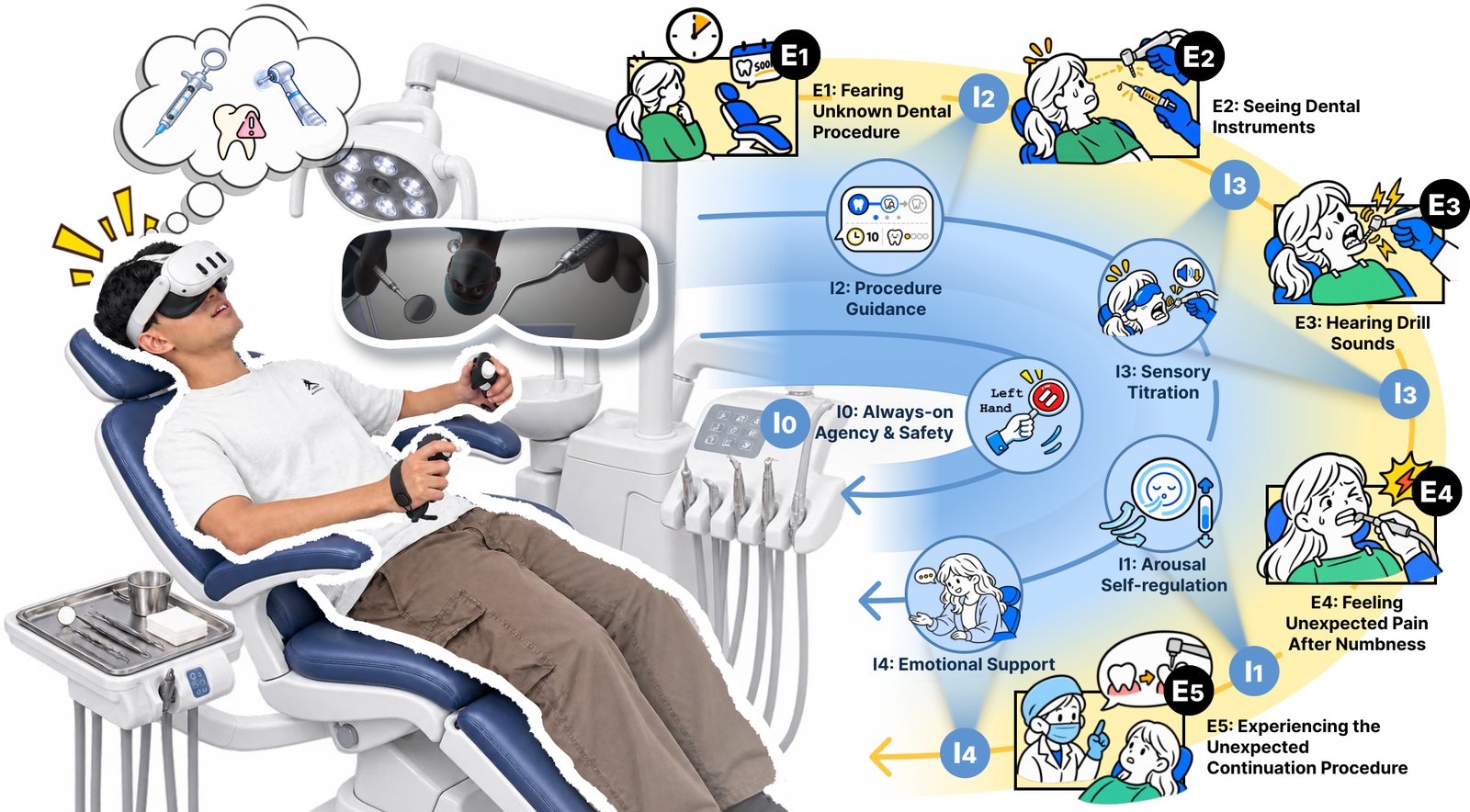
Overview of the event-triggered VR support system for dental anxiety (source: paper)
arXiv 2026 · Human–computer interaction

VR support for dental anxiety

A simulated wisdom-tooth extraction is split into 5 anxiety moments, each met with matching support: procedure guidance, softened sights and sounds, breathing guidance and a virtual companion. Patients can pause or leave at any time. In a 24-person randomized study, anxiety scores in the intervention group averaged 12.8 points lower than in the control group (on a 100-point scale).
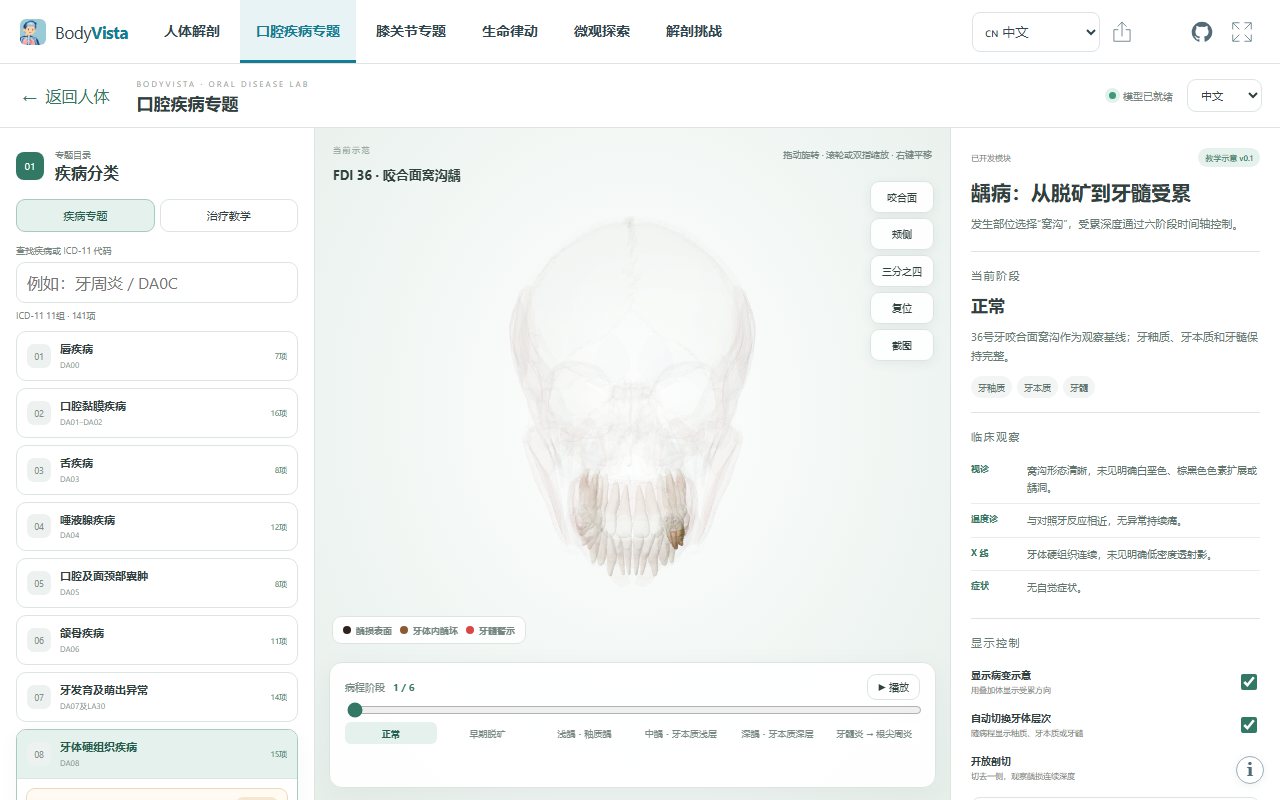
DentalVista oral disease topic: staged demonstration of caries, from demineralization to pulp involvement
3D visualization · Medical education

DentalVista: 3D dental and human anatomy

Built on the open-source BodyVista project. Explore 3D human anatomy and oral disease topics in your browser. Oral diseases are organized into 11 groups and 141 items following ICD-11, and topics such as dental caries show disease progression in staged animations. Section, measure, annotate and take anatomy challenges; on touch screens, rotate with one finger and zoom with two.

Multimodal Data and Specialty Disease Data System

A dental multimodal data foundation covering images, text, long-term follow-up and specialty disease knowledge

90M+medical training and evaluation records
60.51M pairsmedical image–text data, PubMedVision-Plus
26MChinese medical Q&A, Huatuo-26M
120K+annotated dental images, DentalGPT

Data assets

The team has built 90M+ medical training and evaluation records across text, images, video and multiple languages, including medical pre-training and fine-tuning data and expert-annotated data.

Data typeSourceVolume
Medical image–text pre-training dataset
PubMedVision-Plus60,513,727 pairs incl. about 12M high-quality core pairs
Multimodal medical LLM alignment and dialogue dataset
PubMedVision1,294,062
Multimodal medical dialogue dataset
Med-MAT2,360,000
Multimodal medical video generation dataset
MedVideoCap-55K55,000
Multilingual medical text dataset
ApolloMoEDataset292,914
Large-scale medical text dataset
Huatuo-26M26,000,000
Complex-reasoning text dataset
medical-o1-reasoning-SFT50,000
Dental multimodal training set
DentalGPT240,000 incl. 120,000 dental images

Annotation platform

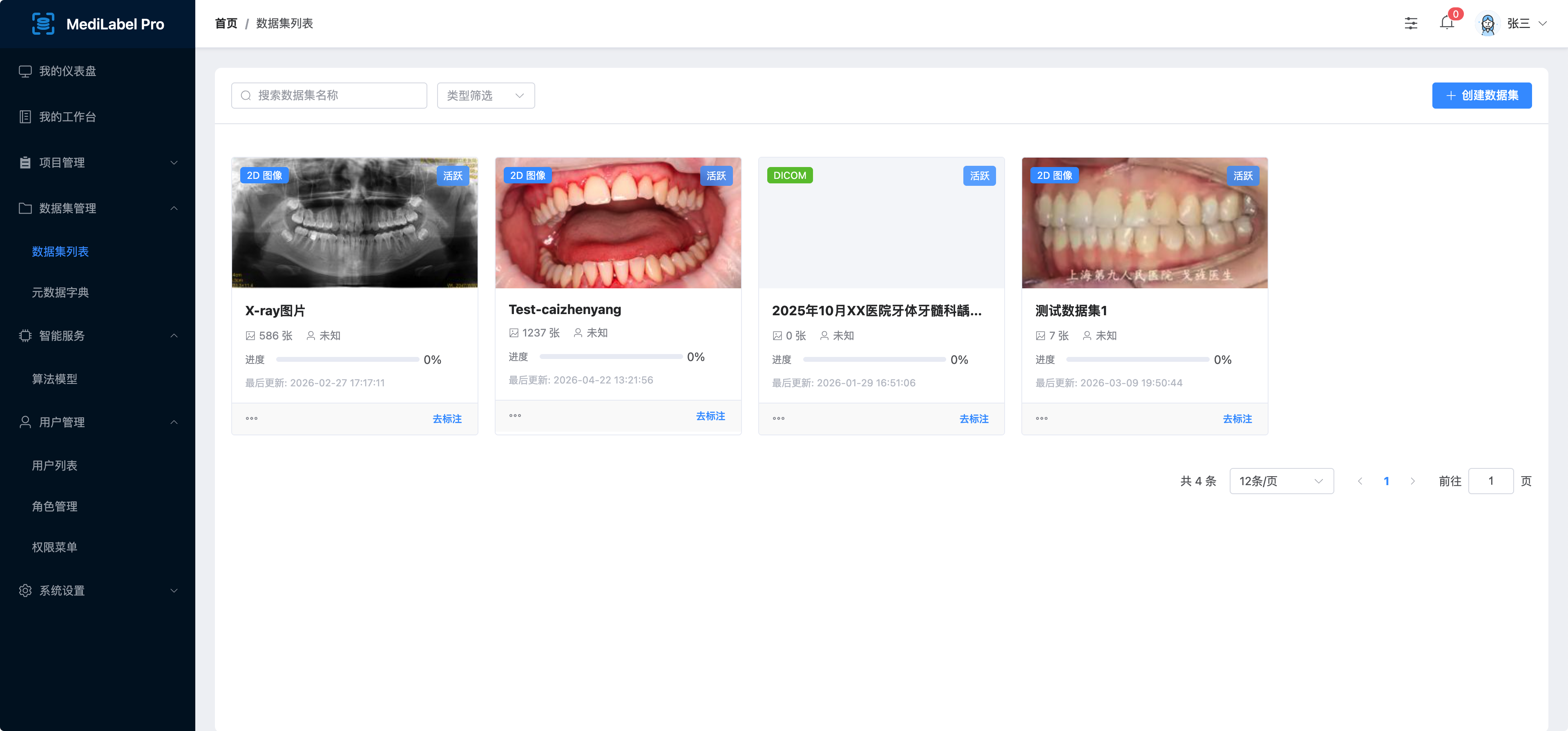
An integrated data production platform covering medical image management, collaborative annotation, review and quality control, and AI pre-annotation.

Medical image data management interfaceCollaborative medical image annotation interface

Dental Benchmarks: GlobalDentBench and OmniDentBench

Multinational, expert-level benchmarks reveal the model's reasoning weaknesses and guide DentalGPT's continuous improvement

"Is this AI model safe, effective and usable in real clinical settings?"

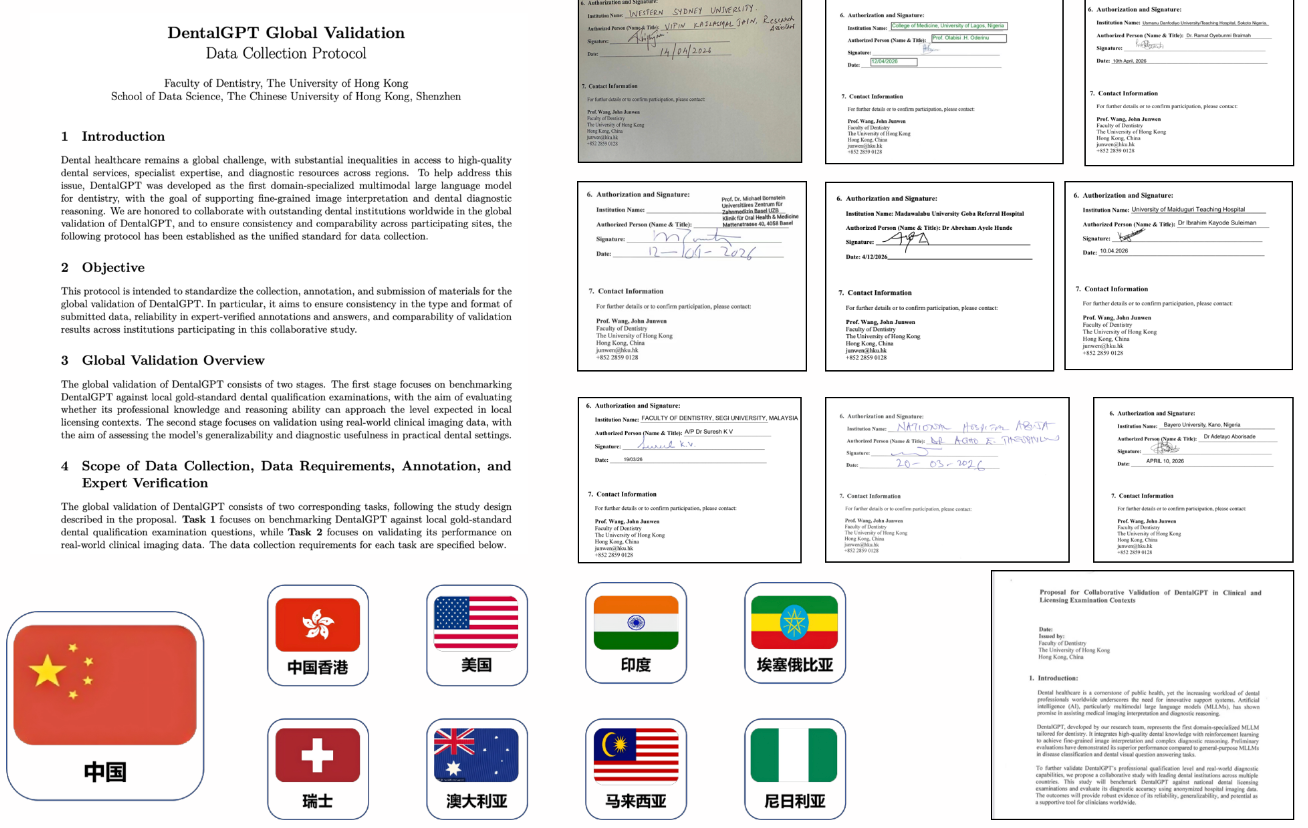
Global Validation and Multicenter Collaboration for DentalGPT

The world's first collaborative validation of a dental large model, building an AI validation network across institutions, regions and populations

Global collaboration agreements

Global collaboration agreements and participating countries and regions

Multicenter collaboration

Clinical expert collaboration

Dental specialists take part in model validation and capability assessment.

Multi-institution data collaboration

A cross-institution, multicenter data validation system.

Joint benchmark building

Jointly building a standardized evaluation system for dental AI.

Joint research

Supporting joint projects, multicenter studies and research translation.

Foundations: from HuatuoGPT-o1 to DentalGPT

DentalGPT builds on the team's long experience with medical large models: its complex-reasoning data follows the HuatuoGPT-o1 method, and its multimodal capabilities extend from understanding to generation

Medical complex reasoning

HuatuoGPT-o1: a medical large model that reasons slowly and thinks long

Unlike math problems, medical reasoning is hard to verify. HuatuoGPT-o1 introduced verifiable medical problems and a medical verifier: the model is first fine-tuned on complex reasoning paths found under the verifier's guidance, then improved with reinforcement learning using verifier-based rewards. With only 40,000 verifiable problems it outperformed general and medical baselines, drawing wide attention.

DentalGPT's first-stage complex-reasoning data follows this method, and its second stage likewise uses automatically graded questions for reinforcement learning. FreedomAI CTO Zhenyang Cai and Chief AI Scientist Benyou Wang are both authors of the paper.

HuatuoGPT-o1's two-stage method: searching complex reasoning paths with verifiable medical problems, then optimizing with reinforcement learningDialogue example from a medical complex-reasoning model
  1. Junying Chen, Zhenyang Cai, Ke Ji, Xidong Wang, Wanlong Liu, Rongsheng Wang, Jianye Hou, Benyou Wang. HuatuoGPT-o1, Towards Medical Complex Reasoning with LLMs. arXiv:2412.18925
  2. Junying Chen, Chi Gui, Anningzhe Gao, Ke Ji, Xidong Wang, Xiang Wan, Benyou Wang. CoD, Towards an Interpretable Medical Agent using Chain of Diagnosis. arXiv:2407.13301
Medical video generation

MedGen: a medical video generation model

Medical videos matter for clinical training, teaching and simulation, yet general video generation models often produce unrealistic or wrong content for medical prompts. The FreedomAI team at The Chinese University of Hong Kong, Shenzhen and FreedomAI released MedVideoCap-55K (55,000+ clips from real medical scenarios, described in the paper as the first large-scale, diverse, caption-rich dataset for medical video generation) and trained MedGen on it. Across several benchmarks, its visual quality and medical accuracy lead open-source models and rival commercial systems.

Exploring MedGen applications

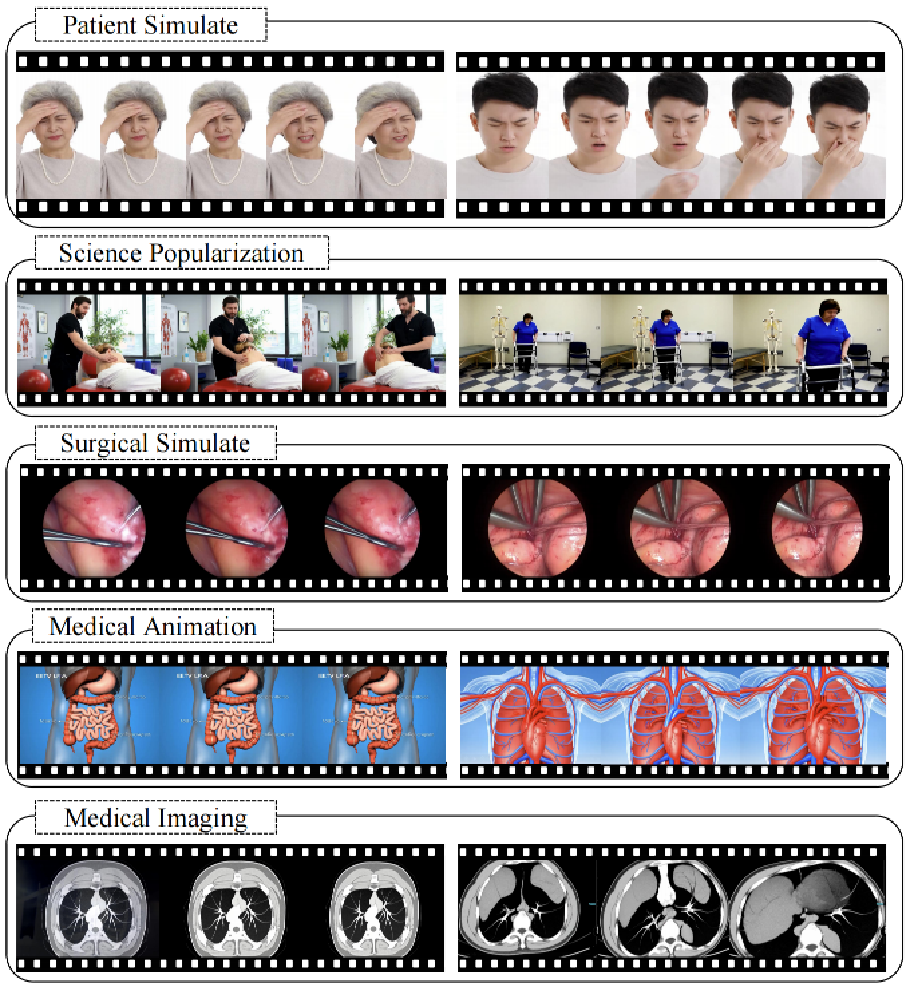
MedGen generates high-quality videos while keeping medical content accurate, for surgical simulation, medical education, science animation and telemedicine.

Data augmentation for downstream tasks

Medical video tasks such as surgical workflow recognition, lesion detection and diagnostic assistance often face scarce labels, imbalanced samples and privacy constraints. Combining MedGen-generated videos with the original training data, we validated MedGen as a data augmentation tool on several medical video classification tasks.

MedGen data augmentation comparison

MedGen vs. HunyuanVideo as data augmentation on three supervised medical video tasks

MedGen applications
MedGen applications in patient simulation, health education, surgical training, medical animation and medical imaging

Team and partner institutions

Author affiliations

Shenzhen Stomatology Hospital (Pingshan) of Southern Medical UniversityThe Chinese University of Hong Kong, ShenzhenPeking UniversityFreedomAIFaculty of Dentistry, The University of Hong KongBeijing Institute of Collaborative InnovationNational Institute of Health Data Science (Shenzhen)Shenzhen Loop Area InstituteShenzhen Research Institute of Big Data