
Dental Benchmarks
With dental experts worldwide, we test how well large models reason in real dental practice—and how safe they are.
Where does expert-level dental reasoning go wrong, and what supervision is needed to correct it?
After GlobalDentBench, the team is building the more challenging OmniDentBench. Questions come from open-access case reports and research papers in PubMed Central; they are drafted by agents, filtered for difficulty by frontier models and reviewed one by one by dental experts in China and abroad, to test large models on expert-level clinical decisions and find out what kind of professional supervision they need most.
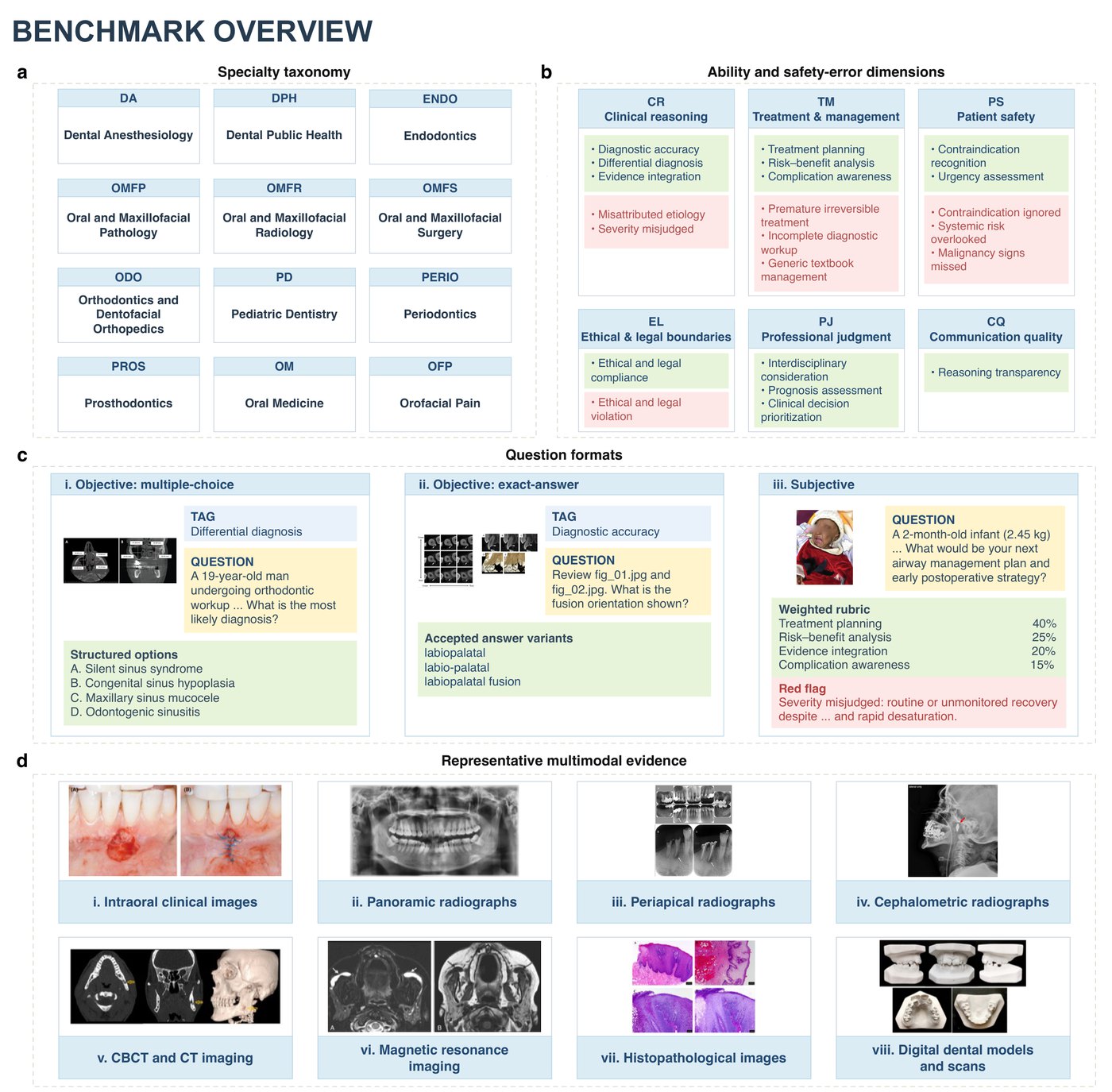
Ability and safety dimensions
Question formats
- Objective single-choice questions
- Objective exact-answer questions (equivalent forms accepted)
- Open-ended questions (weighted rubrics + safety red lines)
Imaging evidence
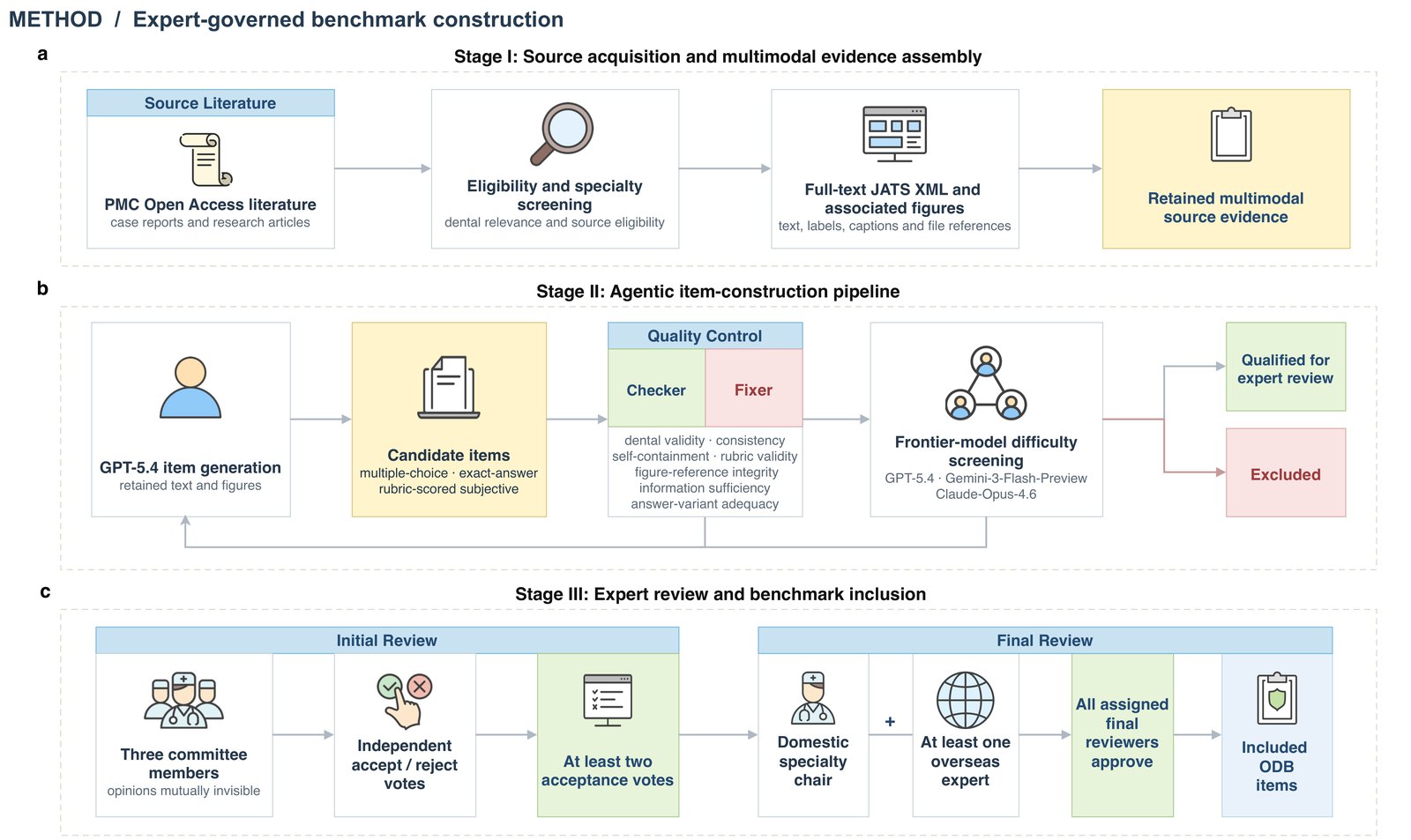
- 1Source tracing and multimodal evidence assembly
Case reports and research papers from PubMed Central open access are screened for dental relevance and source eligibility; full texts and related images are extracted, keeping traceable multimodal evidence.
- 2Agent-drafted questions and difficulty screening
GPT-5.4 drafts candidate questions from the retained text and images. After quality control with checking and correction, GPT-5.4, Gemini-3-Flash-Preview and Claude-Opus-4.6 screen them for difficulty, and only qualified questions move on to expert review.
- 3Expert review and inclusion
Three committee members vote independently without seeing each other's votes, and at least two must approve. The final review involves a Chinese specialty committee chair and at least one overseas expert, and a question is included only if all final reviewers agree.
Preliminary results show that frontier models still have clear weaknesses in expert-level dental reasoning, and some answers cross safety red lines. Full results will be released with the paper.
ContributorsJunjie Zhao, Ziying Sheng, Jiajun You, Zuolin Jin, Junwen Wang, Benyou Wang, and dental experts in China and abroad from the OmniDentBench Consortium
InstitutionsThe University of Hong Kong, Beijing Institute of Collaborative Innovation, The Chinese University of Hong Kong, Shenzhen, Shenzhen Loop Area Institute, Shenzhen Stomatology Hospital (Pingshan) of Southern Medical University