Programme de scénarios ouverts d'IA du gouvernement de Shenzhen | Le Shenzhen Stomatology Hospital (Pingshan) of Southern Medical University déploie une plateforme de soins intelligente sur tout le cycle de vie, avec un triage par IA précis à plus de 95 %
Cet article n'est pas encore disponible en français. La version anglaise est présentée ci-dessous.
The daily running of a dental specialty hospital involves many repetitive, time-consuming tasks: patients ask again and again about procedures before their visit, medical records must be checked one by one after they are written, dentists need to look up professional information at the chair, and large numbers of follow-ups must be organized after treatment. Could AI take on part of this work?
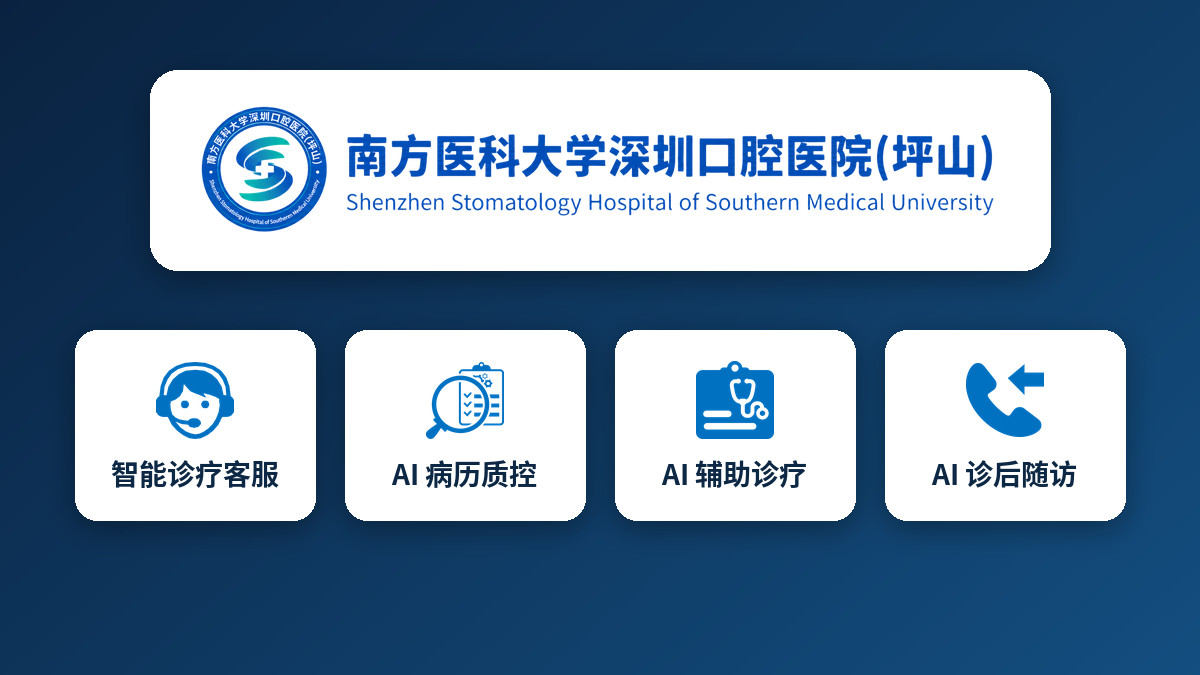
The "integrated intelligent platform for full-lifecycle oral health care", a collaboration between Shenzhen Stomatology Hospital (Pingshan) of Southern Medical University and FreedomAI, offers an answer from real clinical practice. The project received funding from the 2025 Shenzhen special fund for government AI open-scenario applications (15 projects were funded in total). Focusing on patient services, medical quality control, assisted diagnosis and post-visit management, it has deployed four modules in the hospital: an intelligent customer service for patients, AI medical record quality control, AI-assisted diagnosis and treatment, and AI post-visit follow-up. Within the hospital, it involves 170+ clinical staff (dentists, nurses and interns) and 125+ administrative staff (customer service, quality control, IT and others).
Starting from real needs, refined together with the hospital
The platform is built on FreedomAI's AI solutions for healthcare institutions (Figure 1). The approach is to explore intelligent applications together with hospitals around real needs: starting from clinical and operational problems, moving through prototype validation and expert feedback, and then into trial use and iteration in real settings. This process is supported by AI capabilities working together with software engineering, including multimodal AI and agents, professional knowledge and data governance, software development and system integration, and on-premises deployment with ongoing maintenance.
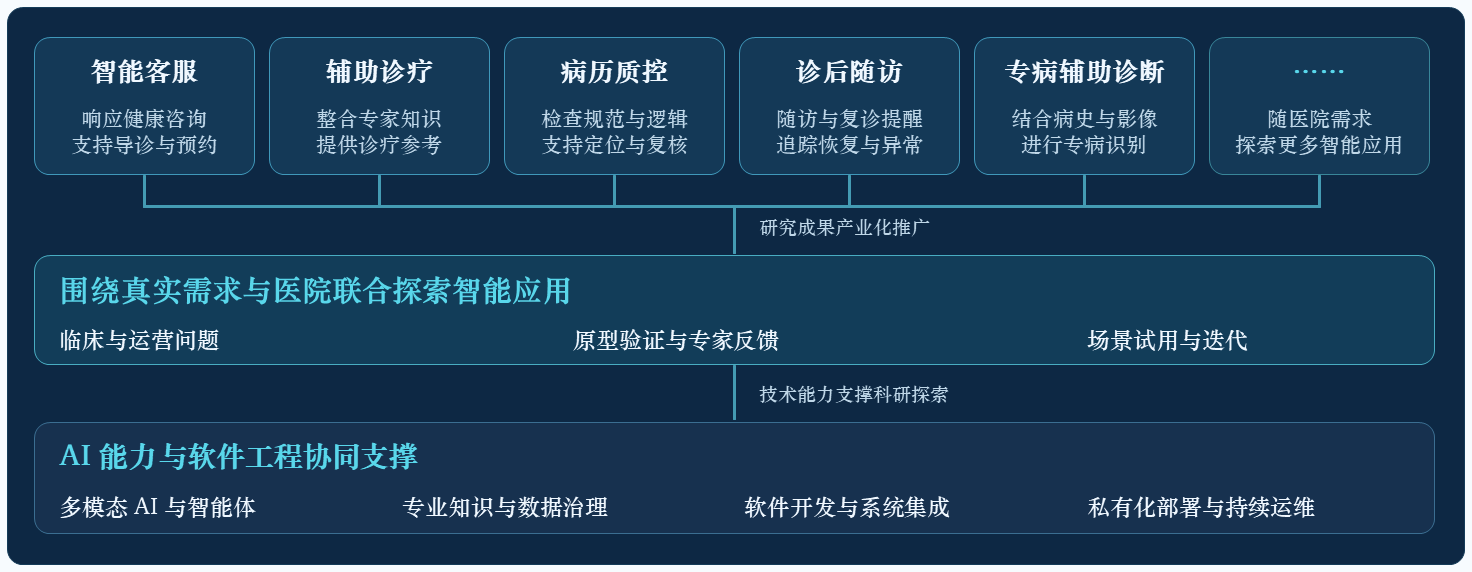 Figure 1: Architecture of FreedomAI's AI solutions for healthcare institutions; the Pingshan project deployed four of its applications: intelligent customer service, assisted diagnosis and treatment, medical record quality control and post-visit follow-up (source: FreedomAI)
In this solution, AI plays a supporting role: medical record quality control keeps human review, and assisted diagnosis and treatment is there to support clinical judgment.
Four modules covering before, during and after the visit
Intelligent customer service: AI triage accuracy above 95%
The intelligent customer service serves patients, answering questions automatically and guiding them through their visit. Project data show that the module's AI triage accuracy is above 95%, its answer accuracy above 98%, and it has served 26,000+ people.
AI medical record quality control: under one minute per record
AI medical record quality control helps check medical records while keeping a human review step: the AI checks records for compliance with standards and for logical consistency, helping quality control staff locate problems and complete their review. AI quality control takes under one minute per record; 14,000+ records have been checked so far, covering the hospital's core departments.
AI-assisted diagnosis and treatment: built into the outpatient workstation
The AI-assisted diagnosis and treatment module brings together professional information to support clinical judgment, and provides knowledge access and a knowledge library. It is integrated into the outpatient doctor workstation of the hospital information system (HIS): by clicking "AI-assisted diagnosis and treatment" on the consultation screen, the dentist receives reference content based on the patient's diagnosis and other information, including an analysis of the condition, possible examinations, diagnostic criteria and treatment measures (Figure 2).
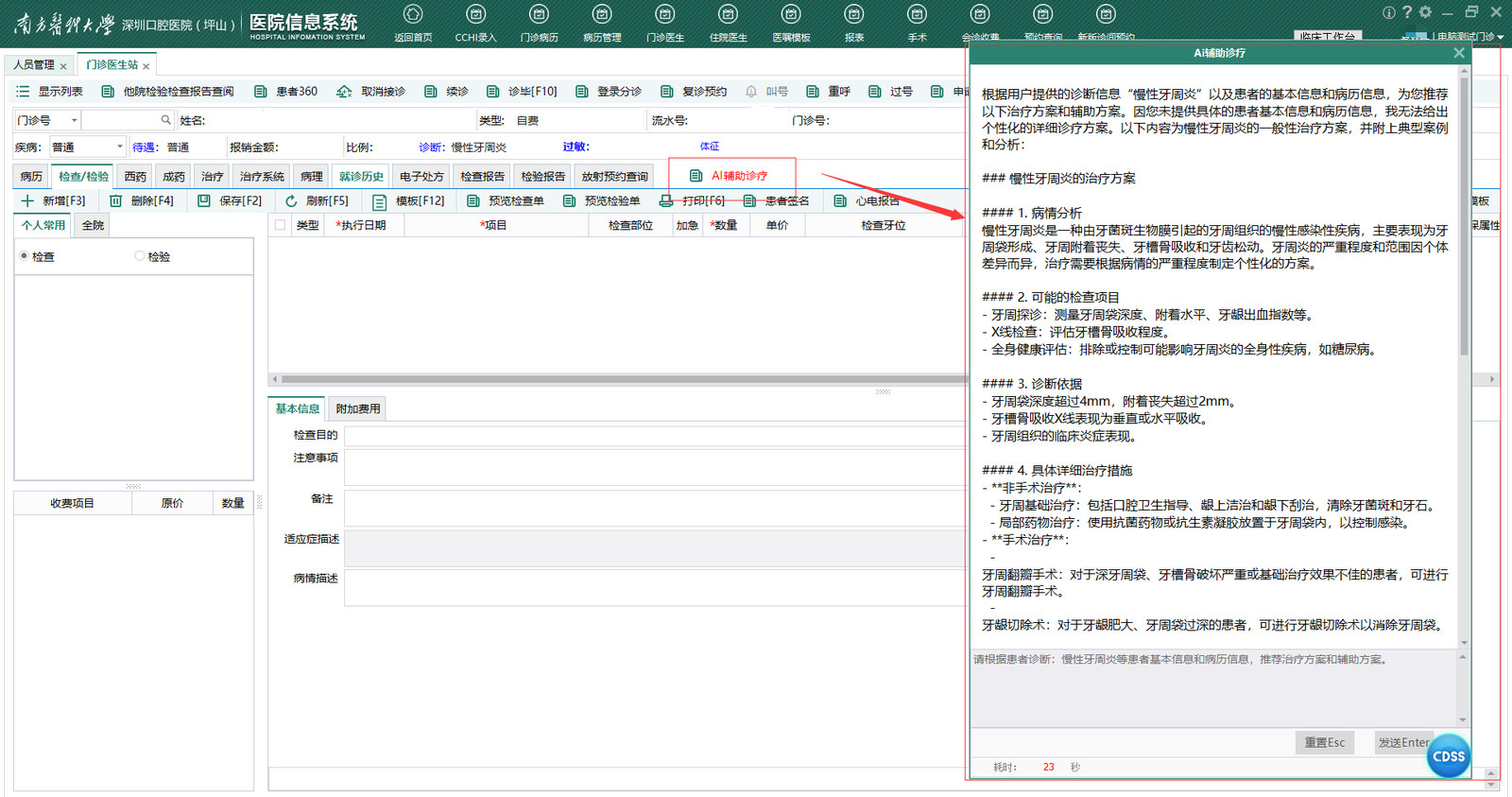 Figure 2: AI-assisted diagnosis and treatment in the outpatient doctor workstation of the hospital information system, giving reference content such as condition analysis, examinations, diagnostic criteria and treatment measures for "chronic periodontitis"; the screenshot shows a test patient with the patient information bar hidden (source: FreedomAI)
AI post-visit follow-up: organized in batches, tracked over time
The post-visit follow-up module supports follow-up tasks after treatment. It can reach and manage patients in batches, record their feedback and flag anything unusual. The ongoing impact of this module has yet to be quantified.
The four modules at a glance
| Module | Role | Project data |
|---|---|---|
| Intelligent customer service | Automatic answers and visit guidance for patients | AI triage accuracy 95%+; answer accuracy 98%+; 26,000+ people served |
| AI medical record quality control | Helps check medical records, with human review retained | Under one minute per record; 14,000+ records checked; covers the hospital's core departments |
| AI-assisted diagnosis and treatment | Brings together professional information to support clinical judgment | Provides knowledge access and a knowledge library |
| AI post-visit follow-up | Organizes follow-ups in batches and tracks feedback | Ongoing impact to be quantified |
Significance and outlook
For FreedomAI, the core value of hospital projects like this lies in refining technology in real settings and building reusable application and delivery capabilities. Shenzhen Stomatology Hospital (Pingshan) of Southern Medical University is also one of the research partners on DentalGPT, the multimodal oral-health large model.
Beyond the Pingshan project, FreedomAI's AI solutions for healthcare institutions have also been deployed at Foshan Stomatological Hospital, in a project on AI-assisted diagnosis of endodontic diseases.