तकनीकी विश्लेषण | DentalAgent: दंत बड़ा मॉडल पेशेवर टूल का उपयोग कर साक्ष्य-आधारित, जाँचने योग्य सहायता देता है
यह लेख अभी हिन्दी में उपलब्ध नहीं है। नीचे अंग्रेज़ी संस्करण दिया गया है।
A single judgment in dental care often means reading a panoramic radiograph and intraoral photos together, taking the medical history and the patient's wishes into account, and being able to explain where the evidence comes from. If a large model simply "looks at the image and answers", its conclusions are hard to trace and hard to fit into a professional workflow.
To tackle this, the FreedomAI team built DentalAgent, an agent framework for professional dental tasks. With a large model at its center, it combines multimodal input, professional tools and medical knowledge to produce evidence-based supporting judgments, so that model capabilities translate into concrete dental tasks.
The framework: one "brain" and a dental toolbox
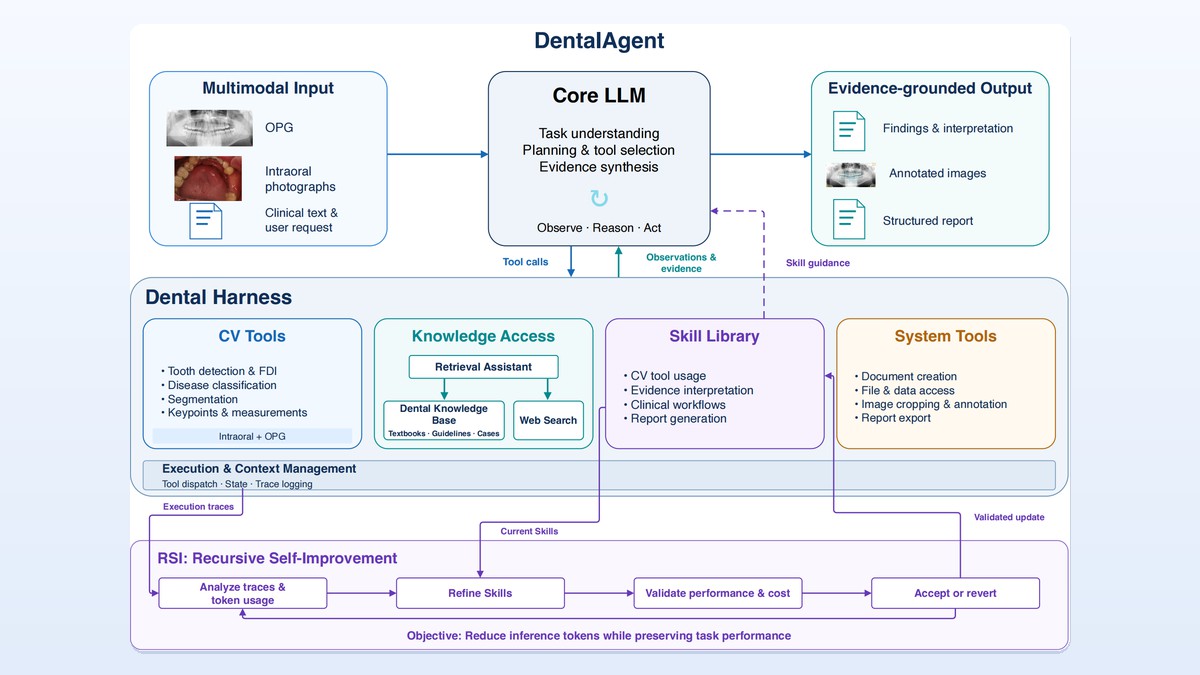
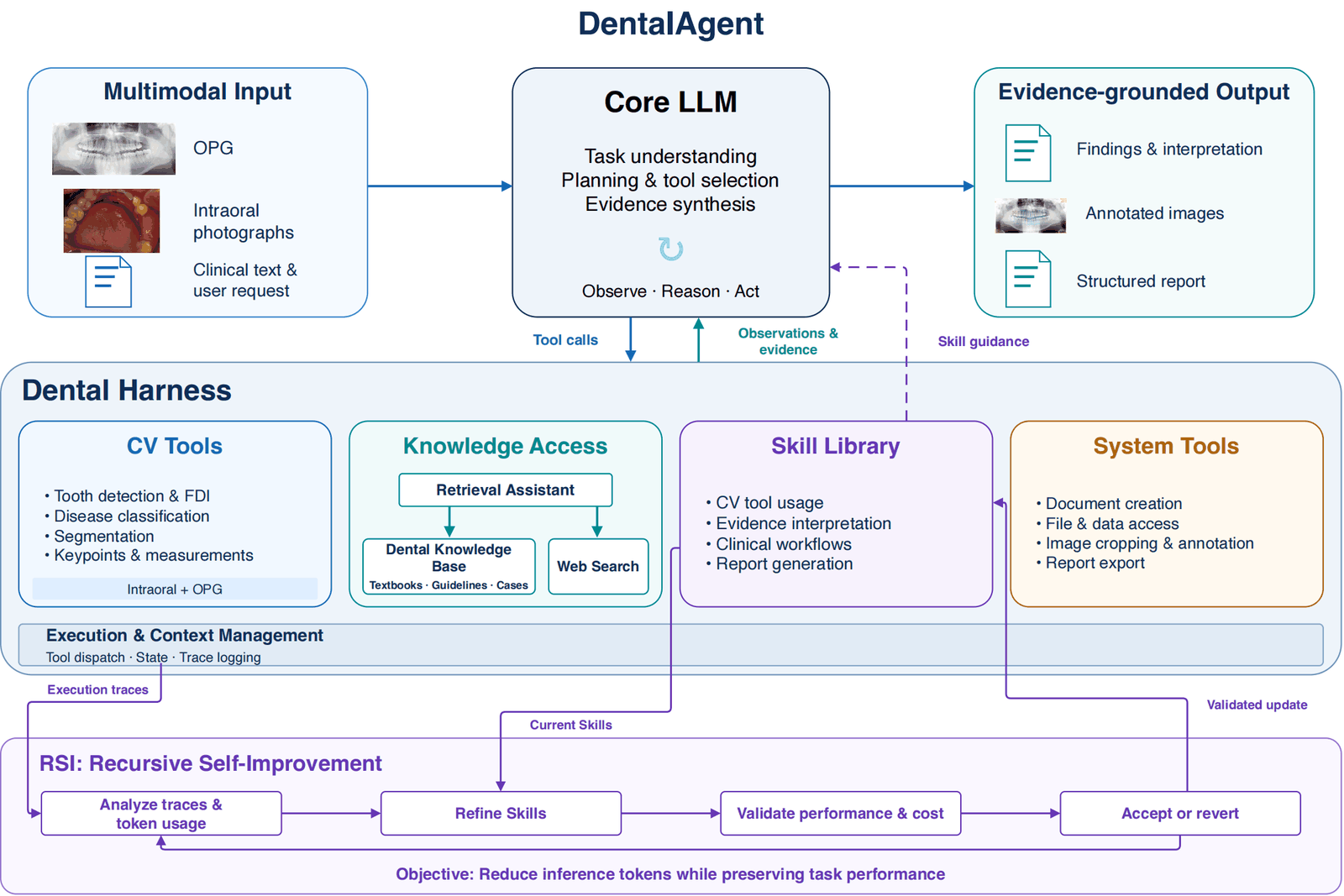 Figure 1: The DentalAgent framework. Source: FreedomAI
DentalAgent has four parts (Figure 1):
- Multimodal input: panoramic radiographs (OPG), intraoral photos, clinical text and user requests.
- Core large model (Core LLM): understands the task, plans and chooses tools, and synthesizes evidence, working step by step in an "observe–reason–act" loop.
- Dental task execution layer (Dental Harness): the large model uses this layer's capabilities through tool calls and gets back observations and evidence.
- Traceable output: findings and interpretation, annotated images and structured reports.
The dental task execution layer brings together four kinds of capability:
- Visual tools: tooth detection with FDI tooth numbering, disease classification, segmentation, and landmarks and measurements, for both intraoral photos and panoramic radiographs;
- Knowledge access: a retrieval assistant connected to a dental knowledge base of textbooks, guidelines and cases, plus web search;
- Skill library: accumulated skills for using visual tools, interpreting evidence, clinical workflows and report generation, giving the large model operating guidance;
- System tools: document creation, file and data access, image cropping and annotation, and report export.
An underlying execution and context management module handles tool scheduling, state maintenance and logging of execution traces.
Three key design choices
Calling professional tools. Steps that need precise visual processing, such as tooth numbering, lesion classification and measurement, are handed to dedicated visual tools; the large model plans the order of calls and integrates the results each tool returns.
Backing by medical evidence. The large model can search the dental knowledge base and the web, and combines tool observations with retrieved knowledge as evidence. It summarizes them into findings, annotated images and structured reports, so that its output rests on evidence.
Continuous feedback and refinement. The framework includes a recursive self-improvement (RSI) loop: it analyzes execution traces and token usage, improves skills accordingly, verifies performance and cost, and then decides whether to accept or roll back the change; updates that pass verification are written back to the skill library. The goal of this loop is to reduce the tokens needed for reasoning while maintaining task performance.
From model capability to professional task execution
If multimodal dental models like DentalGPT are about "seeing clearly and reasoning correctly", DentalAgent focuses on the next step: organizing model capabilities into professional task workflows that can be executed and traced.
DentalAgent is designed to enhance large models with professional tools, knowledge and evidence, improving performance on professional dental tasks. The team is currently running initial evaluations of the framework on dental text tasks and on imaging tasks with intraoral photos and panoramic radiographs.
It is worth stressing that DentalAgent is meant to support judgment: it produces evidence-backed findings, annotated images and reports for dentists to verify and consult, rather than making diagnosis and treatment decisions in their place.